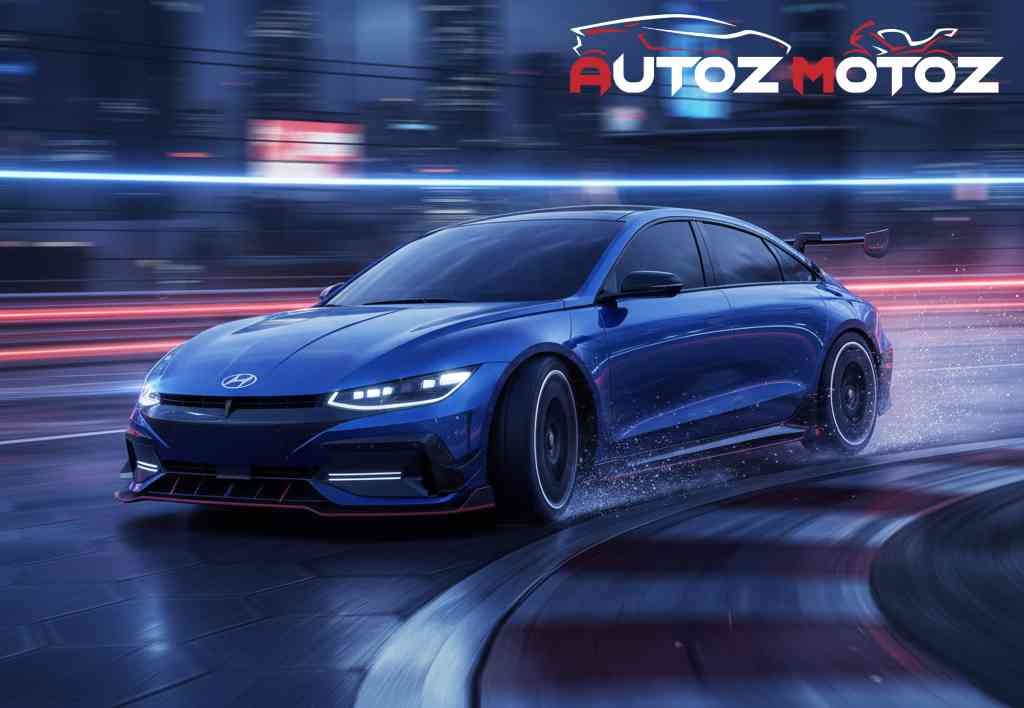
There are cars that perform. Then there are cars that redefine what performance means. The 2026 Hyundai Ioniq 6 N belongs in the second category — a machine that does not simply compete in the electric performance sedan segment but quietly dismantles every benchmark that existed before it arrived.
With 641 horsepower, a 3.2-second 0-60 mph sprint, an 84-kWh 800V battery, a virtual 9-speed gearbox, a configurable drift system, a track-day data acquisition tool, and 18-minute fast charging via a NACS port — the Ioniq 6 N is not an answer to the Tesla Model 3 Performance or the BMW i4 M50. It is the question those cars now have to answer.
Every performance sedan currently on sale is now being measured against this car. Not the other way around.
Ioniq 6 N specs: Everything You Need to Know
Before diving deeper, here is the complete specification picture. These numbers are sourced from Hyundai’s official North American press release (AutoMobility LA, November 2025) and the Korea International Circuit media drive:
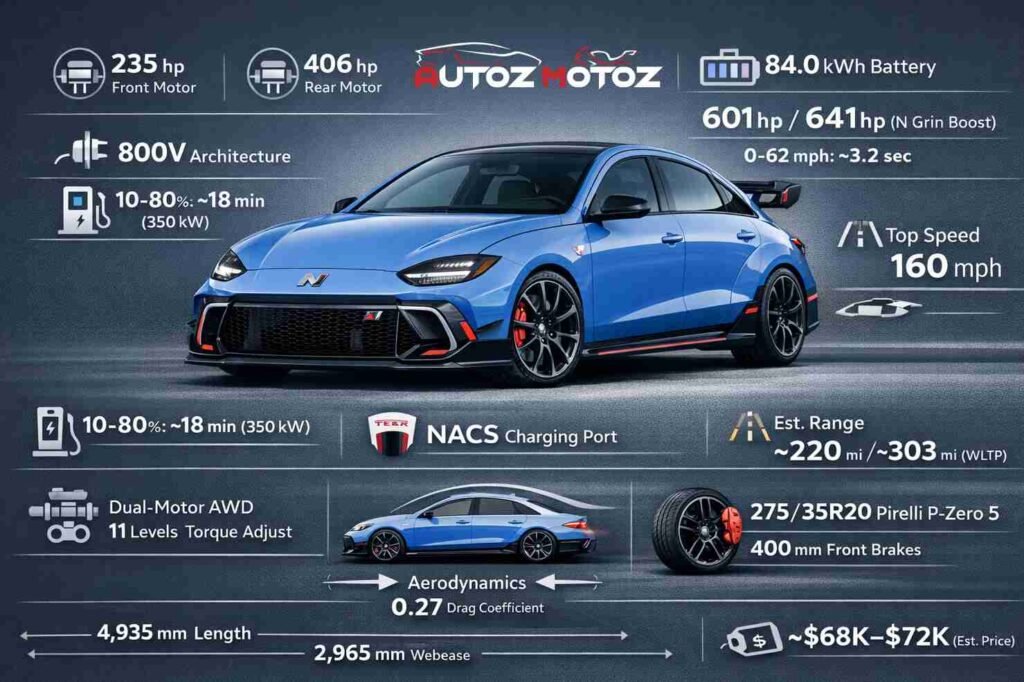
| Specification | Detail |
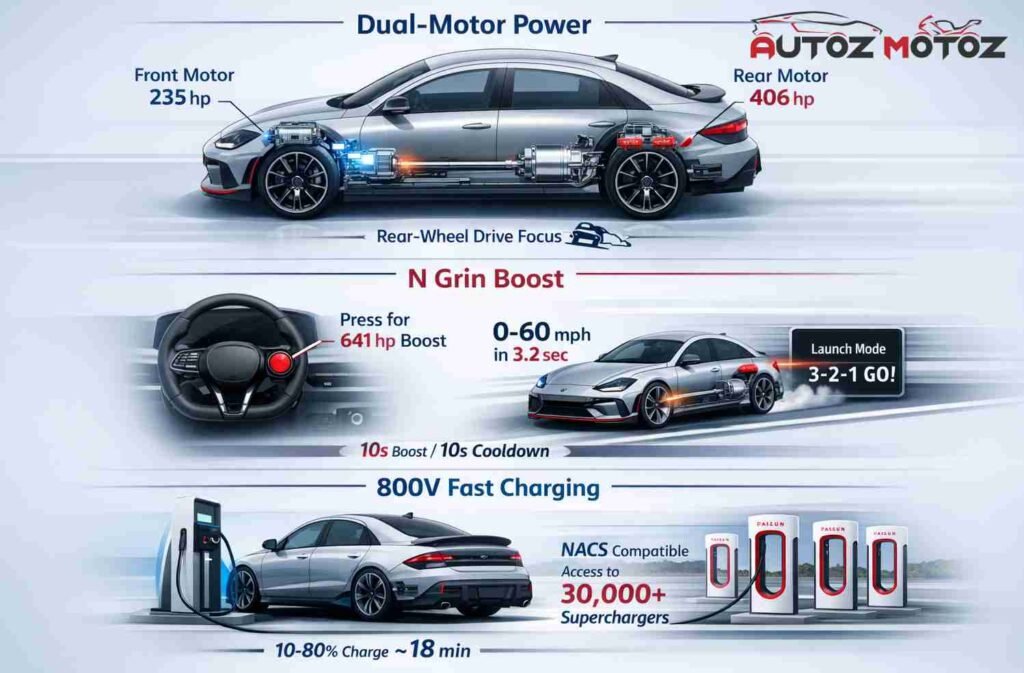
| Front Motor Output | 235 hp (175 kW) |
| Rear Motor Output | 406 hp (303 kW) |
| Combined Power (Standard) | 601 hp (448 kW) / 569 lb-ft (770 Nm) |
| Combined Power (N Grin Boost) | 641 hp (478 kW) — 10-second surge |
| 0–62 mph (N Launch Control + Grin Boost) | ~3.2 seconds |
| Top Speed | 160 mph (257 km/h) |
| Battery Capacity | 84.0 kWh (N Battery — upgraded thermal management) |
| Electrical Architecture | 800V native (400–800V multi-charging compatible) |
| DC Fast Charge (10–80%) | ~18 minutes on 350 kW charger |
| Charging Port | NACS — direct Tesla Supercharger access, no adapter |
| Estimated Range (EPA) | ~220 miles (est., official figure pending) |
| Estimated Range (WLTP) | ~303 miles / 490 km |
| Drive System | Dual-motor AWD, rear-biased torque split |
| Torque Distribution | 11 adjustable levels (front-to-rear) |
| Drag Coefficient | 0.27 Cd |
| Tire Specification | 275/35R20 Pirelli P-Zero 5 (N-specific compound) |
| Brakes (Front / Rear) | 4-piston fixed / 400mm front — 1-piston / 300mm rear |
| Dimensions (L × W × H) | 4,935 × 1,940 × 1,495 mm |
| Wheelbase | 2,965 mm |
| Available Colors (US) | Performance Blue Pearl, Serenity White Pearl, Nocturne Grey Metallic, Nocturne Grey Matte, Abyss Black Pearl |
| Estimated US Price | ~$68,000–$72,000 (official pricing pending) |
641 Horsepower Is Just the Start
Dual-Motor Architecture
Hyundai Ioniq 6 N : front motor contributes 235 hp; the rear motor — the primary driver — delivers 406 hp. The setup is deliberately rear-biased, preserving the character of a traditional performance sedan: responsive, connected, and capable of tail-out behavior when provoked. This is not a crossover with power steering corrections masquerading as a sports car. The weight is low, the center of gravity is lower than the Ioniq 5 N, and the rear does the talking.
N Grin Boost: The Red Button That Changes Everything
Trigger of this car boost from the steering wheel and the Ioniq 6 N surges to its full 641 hp for 10 seconds — then enters a 10-second cooldown. It works in combination with N Launch Control to produce the car’s headline 3.2-second 0-60 figure. To put that in context: the Hyundai Ioniq 5 N recorded a 3.3-second 0-60 and 11.2-second quarter mile at 122.2 mph during Edmunds independent testing — territory the Ioniq 6 N is expected to match or better, given its lower drag, lower CoG, and identical powertrain.
800V Charging: The Real-World Performance Advantage
A performance car that requires 45 minutes to recover range is not a practical performance car. The Ioniq 6 N’s 800V architecture delivers a 10-80% charge in approximately 18 minutes on a 350 kW DC fast charger.
Truely, the NACS port adds access to over 30,000 Tesla Superchargers across North America without an adapter — a decision that fundamentally changes the road-trip equation for this segment. The BMW i4 M50 takes approximately 31 minutes for the same charge window. The Tesla Model 3 Performance takes around 25 minutes. The Ioniq 6 N wins the charging war by a significant margin.
Our lithium-ion battery guide how-do-lithium-ion-battery-compare-to-other-battery-types will help you to compare other company technology , annual output, origin performance and other related information.
Chassis Engineering: Built from the Ground Up
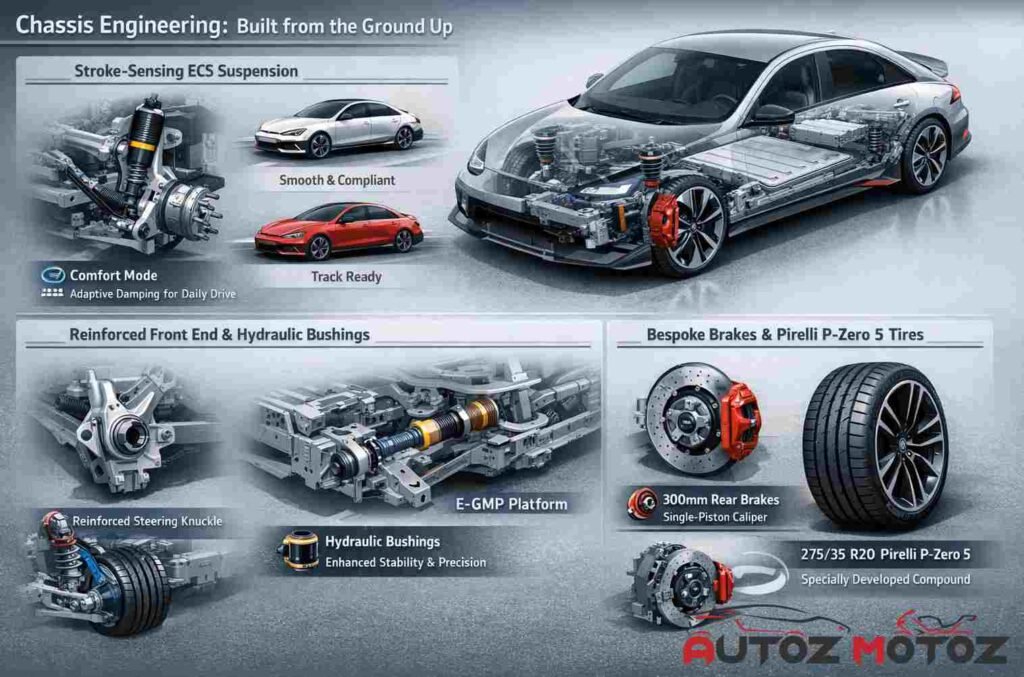
The Ioniq 6 N does not share suspension hardware with the standard Ioniq 6. It is a ground-up chassis engineering exercise on the E-GMP platform.
Stroke-Sensing Electronically Controlled Suspension (ECS)
Especially, The ECS dampers monitor suspension movement in real time and modulate damping forces accordingly. In Comfort mode, the car manages road imperfections with genuine compliance — this is not a bone-dry track car pretending to be daily-drivable. In N mode, the dampers stiffen instantly in response to lateral and longitudinal inputs, keeping the tires planted and the car communicative at the limit.
Reinforced Front End and Hydraulic Bushings
With attention to the steering knuckles are reinforced to handle greater lateral forces. Conventional rubber bushings in the front suspension have been replaced with fluid-filled hydraulic bushings, eliminating fore-aft axle movement under hard braking — a key factor in the steering precision that press-day journalists unanimously praised at the Korea International Circuit first drive in November 2025.
Bespoke Brakes and Pirelli P-Zero 5 Tires
Four-piston fixed calipers on 400mm front rotors and single-piston rear calipers on 300mm discs provide the stopping force. Multiple journalists noted consistent pedal feel across repeated hot laps without fade.
The 275/35R20 Pirelli P-Zero 5 tires are not off-the-shelf — Hyundai and Pirelli co-developed a compound specific to the Ioniq 6 N’s weight distribution, power delivery, and thermal profile. This is the kind of detail that places the car in company well above its price point.
N’s Technology: 8 Systems That Redefine EV Performance
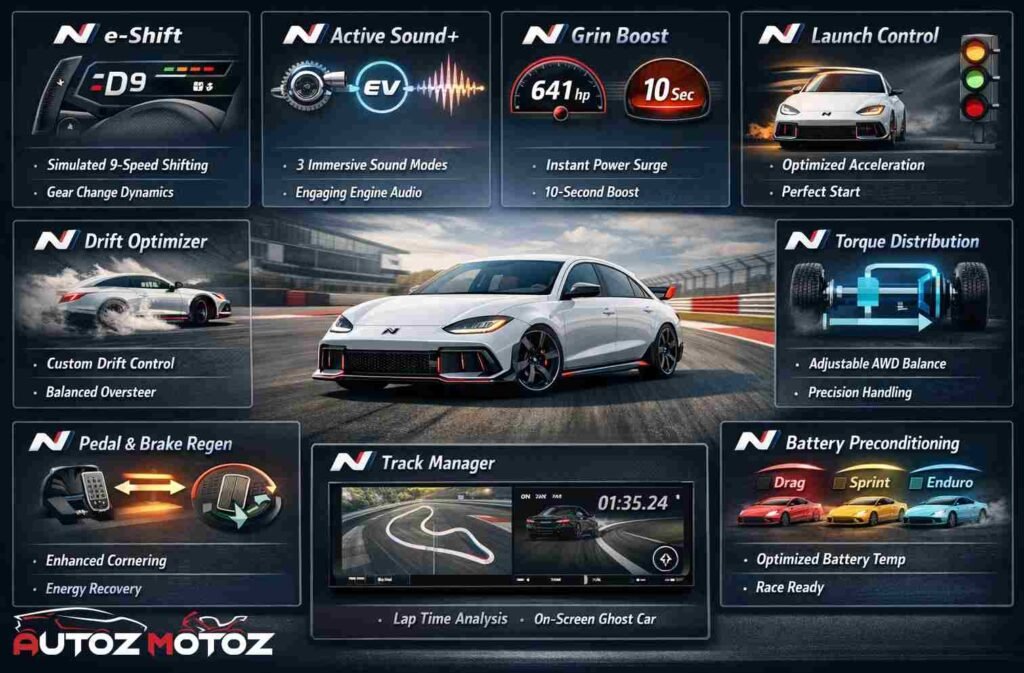
In reality, the Ioniq 6 N separates itself from every other performance EV on the market. Hyundai’s N division built a suite of systems that address the one legitimate criticism of fast EVs — that they are quick but not engaging. Every item below is a genuine engineering intervention, not a marketing checkbox.
6 N is the first performance EV where the driver engagement software is as sophisticated as the powertrain. That is a sentence no competitor can claim in 2026.
Why It Will be Consider – Advantages
| N System | What It Does | Why It Matters |
| N e-Shift | Simulates a 9-speed dual-clutch transmission via motor torque modulation + paddles | Delivers gear-change rhythm and rev buildup |
| N Active Sound+ | 3 selectable soundscapes: Ignition (turbocharged), Evolution (EV heritage), Lightspeed (sci-fi) | Closes the sensory gap between ICE and EV performance — you hear what the car is doing |
| N Grin Boost | 10-second surge to 641 hp via steering wheel button (10-sec cooldown) | Transforms every straight into a performance event — on demand |
| N Launch Control | Real-time traction-optimized torque modulation at standing start | Delivers brutally consistent 0-62 times across surface conditions |
| N Drift Optimizer | Customizable drift initiation intensity, angle, and permitted wheel spin | Genuine, controllable oversteer — not a stability system bypass but a tuned torque vectoring mode |
| N Torque Distribution | 11 discrete front/rear torque split levels | From rain-safe AWD to track-ready rear-biased — granular control no competitor offers |
| N Track Manager | In-car lap timer, custom track mapping, ghost car overlay on dual 12.3″ screen | A track-day data tool that rivals standalone data loggers — built into the car’s infotainment |
| N Pedal | Front motor friction to shift weight forward at corner entry (3 intensity levels) | Mimics trail-braking effect without using brake pedal — reduces understeer, improves corner speed |
| N Brake Regen | Regenerative braking up to 0.6g deceleration via paddles | Recovers energy during braking phases on circuit — extends performance window of battery |
| N Battery Preconditioning | Drag / Sprint / Endurance thermal modes to prep battery for session type | Solves the track-day thermal throttling problem that hampers every performance EV |
| N Ambient Light Shift | Cabin ambient lighting acts as a visual shift indicator (pulses at simulated redline) | The entire cockpit participates in the driving experience — not just the instrument cluster |
Hyundai Ioniq 6 N vs. Tesla Model 3 vs. BMW i4 M50 vs. BMW M3
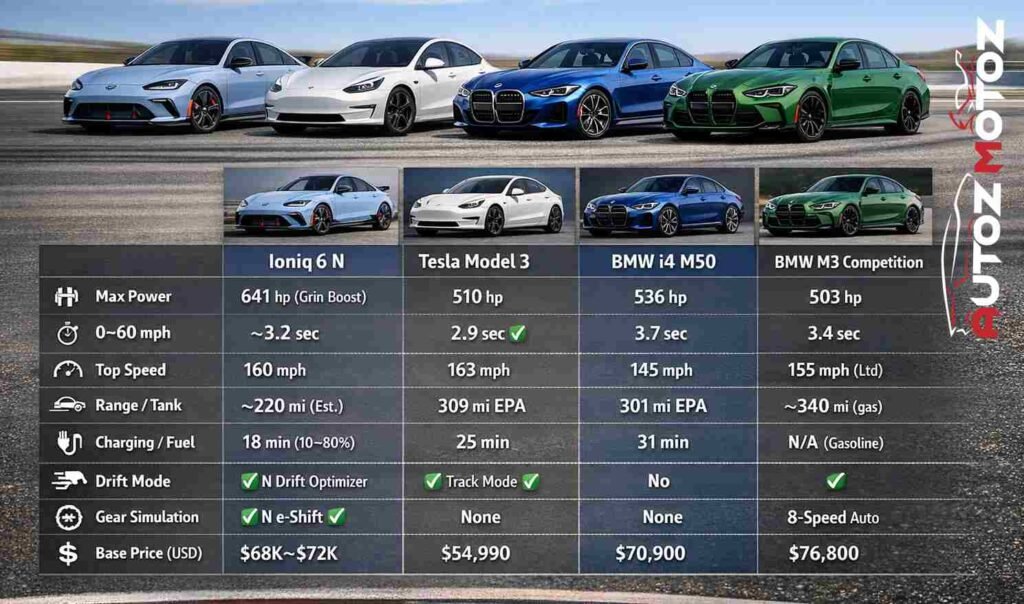
These four cars represent the realistic purchase decision for a performance sedan buyer in 2026. Here is the honest comparison:
| Spec / Feature | Ioniq 6 N | Tesla Model 3 | BMW i4 M50 | BMW M3 |
| Max Power | 641 hp (Grin Boost) | 510 hp | 536 hp | 503 hp |
| 0–60 mph | ~3.2 sec | 2.9 sec | 3.7 sec | 3.4 sec |
| Top Speed | 160 mph | 163 mph | 145 mph | 155 mph (ltd) |
| Est. Range / Tank | ~220 mi (EPA est.) | 309 mi EPA | 301 mi EPA | ~340 mi (gas) |
| Battery / Engine | 84 kWh / 800V | 82 kWh | 83.9 kWh | 3.0L Turbo-6 |
| DC Charge (10–80%) | ~18 min | ~25 min | ~31 min | N/A — gas |
| Charging Port | NACS | NACS | CCS2/J1772 | N/A |
| Drift / Oversteer Mode | Yes — N Drift Optimizer | Yes — Track Mode | No | Yes — M Traction |
| Simulated Gearshift | Yes — 9-speed N e-Shift | No | No | 8-speed ZF real |
| Track Lap System | N Track Manager + ghost car | Track Mode only | No | M Track Coach |
| Torque Distribution | 11 adjustable levels | Binary (Auto/Sport) | xDrive preset | M xDrive presets |
| Sound Design | 3 profiles (N Active Sound+) | None | None | Real exhaust |
| Base Price (US, est.) | ~$68,000–$72,000 | $54,990 | $70,900 | $76,800 |
| Value per HP (est.) | ~$109–$112/hp | ~$108/hp | ~$132/hp | ~$153/hp |
vs. Tesla Model 3 Performance
0-60 time (2.9 vs 3.2 seconds), range (309 vs ~220 miles), and starting price. Those are real advantages. But the Model 3 Performance offers no drift optimizer, no simulated shifting, no track lap system with ghost car, no multi-level torque distribution, and no sound design. It is an exceptional point-A-to-point-B performance machine.
The Ioniq 6 N is a complete driver’s car. For buyers who will use these cars on track or simply want richer engagement every time they drive, the gap in the technology suite is decisive.
vs. BMW i4 M50
At $70,900 base with a 3.7-second 0-60, the i4 M50 is slower, pricier per performance unit, and charges nearly twice as slowly as the Ioniq 6 N. BMW’s brand cachet and interior refinement remain strengths, but the Ioniq 6 N matches or exceeds it on every measurable performance metric. The i4 M50 has no drift mode, no simulated transmission, and no dedicated track data system. The verdict is straightforward.
vs. BMW M3 Competition
Moreover, The M3 Competition is still the most emotionally compelling performance sedan made — the inline-six soundtrack, the mechanical directness, the decades of motorsport DNA. The Hyundai Ioniq 6 N is not trying to replace that experience. It is building a different and valid one. But at $76,800 for the M3 Competition vs. approximately $68-72K for the Ioniq 6 N, the Korean car offers more horsepower, quicker acceleration, lower running costs, and a track tool set the M3 Competition does not include.
The cases for both cars are strong. But for a buyer willing to embrace electrification, the Ioniq 6 N wins on value and performance breadth.
Design: Aerodynamics With a Purpose
Exterior
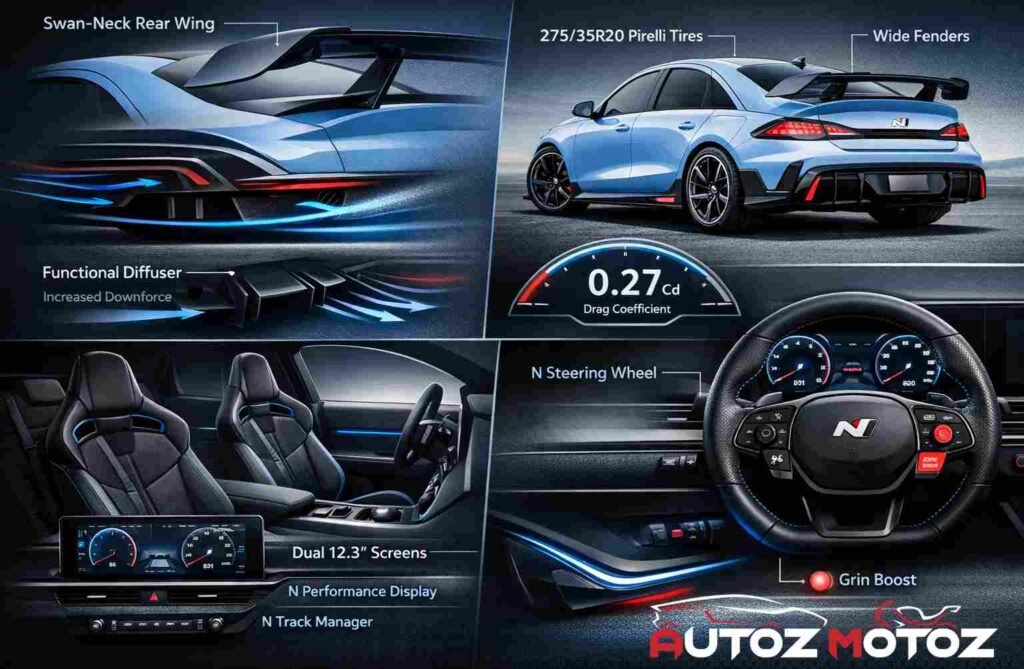
The Ioniq 6 N’s swan-neck rear wing mounts from above — a GT racing-derived configuration that keeps the aerodynamic surface in undisturbed air. Combined with a functional underbody diffuser, it generates genuine downforce while contributing to the car’s 0.27 Cd drag coefficient — lower than the Ioniq 5 N’s 0.313 Cd despite wider fenders, bigger tires, and significantly more aero hardware.
Of course, The wider front and rear fenders are structural, not cosmetic: they house the 275/35R20 Pirelli package that gives the car its cornering grip. Five exterior colors are available in the US market, with Performance Blue Pearl as the N-signature shade.
Interior
The cabin is purpose-built. Manually adjustable N bucket seats wrap in a leather and Alcantara combination; the door cards and dashboard receive suede-feel trim surfaces. The steering wheel features a dedicated N button and the N Grin Boost trigger — a red button that becomes instinctive within five minutes of driving.
The dual 12.3-inch screen architecture from the standard Ioniq 6 is retained, with the driver display gaining dedicated N performance readouts and the N Track Manager interface.
In addition, Ambient Light Shift runs ambient lighting strips that pulse as a visual shift indicator — the cockpit itself becomes part of the performance communication system. The interior is exclusively black with Performance Blue accents.
Daily Use: Does the Ioniq 6 N 0-60 Work Every Day?
N’s design philosophy — Hyundai N’s Everyday Sportscar directive — demands that track capability and daily practicality coexist without compromise. The evidence suggests they do.
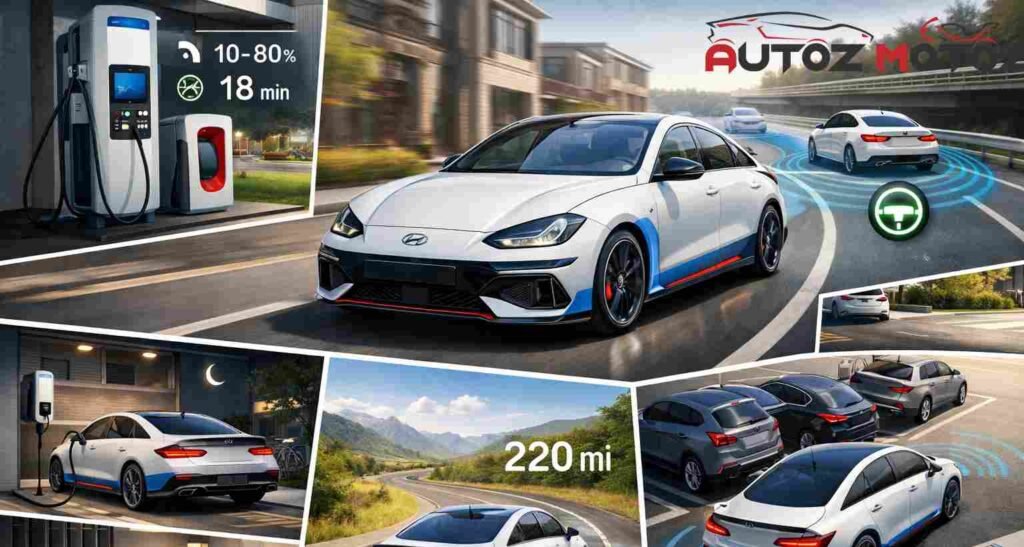
In Comfort mode, the ECS adaptive suspension absorbs road imperfections effectively enough that multiple journalists described it as fully livable for extended drives. The NACS port and 800V charging make range anxiety a manageable rather than crippling constraint: 18 minutes from 10-80% at a growing network of 350 kW chargers, plus access to Tesla Superchargers, means that on a road trip the car charges faster than most people return from a coffee stop.
Particularly, the estimated 220-mile EPA range — lower than rivals due to the wider tires, more aggressive aero setup, and performance-tuned battery calibration — is the car’s only genuine daily-use caveat.
For drivers whose daily distance exceeds 150 miles without a charging opportunity, this requires planning. For the majority of performance car buyers who drive 30 to 80 miles daily and charge overnight at home, it is not an issue. The car also includes the full Hyundai SmartSense ADAS suite: Highway Driving Assist 2, forward collision avoidance, blind-spot monitoring with active intervention, and Remote Smart Parking Assist 2.
Frequntly-Asked-Questions
| Question | Direct Answer |
How fast is the Hyundai Ioniq 6 N? | 0-60 mph in ~3.2 seconds with N Launch Control and N Grin Boost. Top speed is 160 mph. |
How much horsepower does the Ioniq 6 N have? | 601 hp standard output, 641 hp with N Grin Boost active (available for 10 seconds at a time). |
What is the Ioniq 6 N’s battery size? | 84.0 kWh N Battery with upgraded thermal management versus the standard Ioniq 6. |
How long does the Ioniq 6 N take to charge? | ~18 minutes from 10-80% on a 350 kW DC fast charger, via 800V architecture. |
Can the Ioniq 6 N use Tesla Superchargers? | Yes. It ships with a NACS port — no adapter required for the Tesla Supercharger network. |
What is N e-Shift? | A system that simulates a 9-speed dual-clutch gearbox through motor torque modulation and steering wheel paddle inputs — with corresponding sound and ambient light feedback. |
Does the Ioniq 6 N have a drift mode? | Yes. N Drift Optimizer allows the driver to configure drift initiation intensity, drift angle, and permitted wheel spin. |
Is the Ioniq 6 N faster than the Tesla Model 3 Performance? | The Model 3 Performance is quicker 0-60 (2.9 vs 3.2 sec). The Ioniq 6 N has 131 more hp, superior charging speed, and a far more complete track/engagement technology suite. |
How much does the Hyundai Ioniq 6 N cost in the US? | Official pricing not confirmed. Based on the Ioniq 5 N’s $67,475 base, the Ioniq 6 N is expected between $68,000–$72,000. |
When is the Hyundai Ioniq 6 N available in the US? | Limited US availability is expected from mid-2026 onward, following the global debut at AutoMobility LA in November 2025. |
Conclusion
In other words, the 2026 Hyundai Ioniq 6 N is the most complete electric performance sedan currently available or announced. It is faster than the BMW i4 M50. It charges quicker than the Tesla Model 3 Performance. It is more technologically engaging than both. It offers a drift mode, a simulated 9-speed gearbox, a track lap system with ghost car overlay, 11-level torque distribution, dedicated battery thermal management, and three selectable soundscapes — in a car that starts under $72,000 and offers 641 hp on demand.
As a result, this car is already one of the most aerodynamically efficient sedans in the world. The Ioniq 6 N takes that foundation and transforms it into the sharpest performance tool in its class — without surrendering the daily usability that makes the platform so compelling in the first place.

Technical precision in motorcycles, cars, and automotive gear is established by Nahid Hassan through rigorous evaluation. Performance-driven reviews and high-value affiliate insights are consistently curated at AutoZMotoZ to ensure reader trust. Absolute integrity is maintained in every analysis, with a focus on original and human-verified data.