Fuel efficiency is one of the biggest reasons drivers choose a compact SUV—but manufacturer numbers don’t always tell the full story.
In real-world conditions—traffic, heat, short trips, and inconsistent driving habits—fuel economy can vary significantly. From experience working with different vehicles and usage patterns, the most efficient compact SUVs are not just the ones with the highest official ratings, but the ones that maintain consistent efficiency across daily driving conditions.
This is where factors like hybrid technology, engine tuning, transmission behavior, and overall vehicle weight start to matter more than simple MPG claims.
Why Compact SUVs Are Improving in Fuel Efficiency
Modern compact SUVs are designed to balance fuel economy, practicality, and performance. Unlike older models that prioritized size and power, newer vehicles focus on:
- Optimized engine performance
- Improved aerodynamics
- Advanced transmission systems
- Hybrid and electrified powertrains
From a technical standpoint, hybrid systems have changed the efficiency benchmark, especially in urban driving where stop-and-go traffic allows regenerative braking to recover energy.
The Most Fuel-Efficient Compact SUVs (Based on Real Performance Trends)
Hybrid-Dominant Leaders
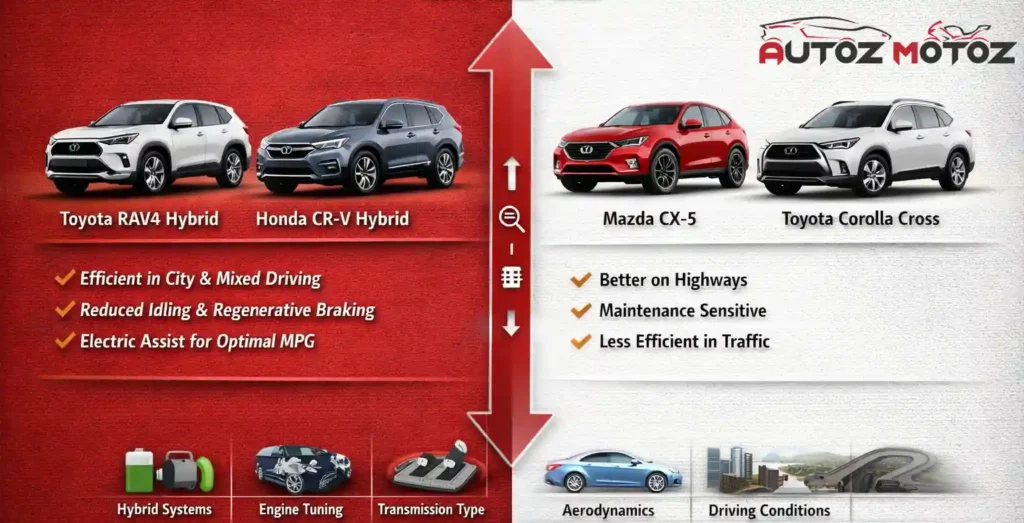
Vehicles like the Toyota RAV4 Hybrid and Honda CR‑V Hybrid consistently deliver strong fuel economy not just on paper, but in actual driving.
From experience and user feedback:
- These models maintain stable fuel consumption in city traffic
- Hybrid systems reduce fuel waste during idling
- Engine load is optimized through electric assist
The Hyundai Tucson Hybrid also stands out, particularly in mixed driving conditions where both engine and electric systems balance efficiency well.
What separates these vehicles is not just MPG ratings, but how predictable and consistent their fuel usage remains over time.
Strong Gasoline Alternatives
While hybrids lead in efficiency, some gasoline-powered compact SUVs still perform well when properly maintained.
Models like the Mazda CX‑5 and Toyota Corolla Cross offer respectable fuel economy, especially in highway driving.
However, in real-world conditions:
- Fuel efficiency drops more noticeably in traffic
- Engine load increases without hybrid support
- Driving style has a greater impact
This makes them more sensitive to maintenance and driving habits compared to hybrids.
Real-World Case Insight: Why Some SUVs Perform Better Than Others
In practical scenarios, I’ve seen two vehicles with similar official fuel ratings perform very differently.
One case involved a hybrid compact SUV and a standard gasoline model used in similar city conditions:
- The hybrid maintained consistent fuel efficiency even in heavy traffic
- The gasoline SUV showed fluctuating consumption depending on driving patterns
The difference came down to:
- Energy recovery systems (hybrid advantage)
- Reduced idle fuel consumption
- Better load distribution between engine and electric motor
This highlights an important point:
Fuel efficiency is not just about engine size—it’s about how efficiently energy is managed.
Explore more from AutozMotoz news
What Actually Determines Fuel Efficiency in Compact SUVs
Fuel economy is influenced by several interconnected factors:
- Engine efficiency and tuning
- Transmission type (CVT vs automatic)
- Vehicle weight and aerodynamics
- Hybrid system integration
- Driving conditions and traffic patterns
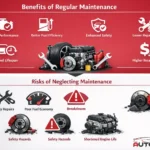
From an ownership perspective, consistent maintenance also plays a critical role. Even the most efficient SUV can lose its advantage if:
- Air filters are clogged
- Tire pressure is incorrect
- Engine oil is degraded
Hybrid vs Gasoline: Which Is Truly More Efficient?
From a purely technical and real-world standpoint, hybrid compact SUVs are currently the most fuel-efficient option.
They perform best in:
- Urban environments
- Stop-and-go traffic
- Daily commuting
Gasoline SUVs, while still efficient, tend to perform better on:
- Highways
- Long-distance driving
However, in mixed driving conditions—which most drivers experience—hybrids consistently deliver better overall efficiency.
Common Misconceptions About Fuel Efficiency
One of the biggest misunderstandings is that smaller SUVs automatically consume less fuel. In reality, drivetrain technology and system efficiency matter more than size alone.
Another misconception is that manufacturer MPG ratings reflect real-world usage. These numbers are often achieved under controlled conditions and may not match everyday driving environments.
“I know your daily life is boring but if you really love your car or this industry we gather regular basis guideline how to care, maintenance, reviews, news and best product recommendation from Amazon, we have an id to do affiliate with their attractive automotive product. You can check article – click to explore
Final Perspective
Fuel-efficient compact SUVs are no longer defined by engine size alone. The shift toward hybrid technology, energy management systems, and optimized vehicle design has changed how efficiency is achieved.
From real-world experience, the most efficient models are those that:
- Maintain consistent fuel consumption
- Adapt well to different driving conditions
- Combine engine performance with intelligent energy use
For most drivers, especially in urban and mixed environments, hybrid compact SUVs currently offer the best balance of fuel efficiency, reliability, and long-term cost savings.
FAQ
1. Do hybrid compact SUVs actually save fuel in real driving conditions?
Yes, especially in city driving. In real-world conditions like traffic and short trips, hybrid systems reduce fuel consumption by using electric power at low speeds and during idling. This makes them noticeably more efficient than gasoline SUVs in urban environments.
2. Which compact SUV has the best real-world fuel economy, not just official ratings?
Models like the Toyota RAV4 Hybrid and Honda CR-V Hybrid are often reported to deliver consistent fuel efficiency in daily use. They perform well across both city and highway driving, not just under test conditions.
3. Are compact SUVs less fuel-efficient than sedans?
In general, yes. Sedans are lighter and more aerodynamic, which improves fuel efficiency. However, modern hybrid compact SUVs have closed the gap significantly and can offer comparable efficiency with added space and practicality.
4. Does driving style affect fuel efficiency in compact SUVs?
Absolutely. Aggressive acceleration, frequent braking, and high-speed driving can reduce fuel efficiency significantly. Smooth driving, steady speeds, and proper maintenance help maximize mileage in any SUV.
5. Is it worth paying more for a hybrid compact SUV?
For most drivers, especially those who drive in city traffic, the long-term fuel savings often offset the higher upfront cost. Hybrid systems also reduce engine strain, which can improve long-term reliability.
6. Why does my SUV not match the advertised fuel economy?
Official fuel economy figures are tested under controlled conditions. In real-world driving, factors like traffic, weather, road conditions, and vehicle load can all affect actual fuel consumption.
7. Do compact SUVs lose fuel efficiency over time?
Yes, if maintenance is neglected. Dirty air filters, low tire pressure, worn spark plugs, and degraded engine oil can all reduce efficiency. Regular servicing helps maintain optimal fuel economy.

Technical precision in motorcycles, cars, and automotive gear is established by Nahid Hassan through rigorous evaluation. Performance-driven reviews and high-value affiliate insights are consistently curated at AutoZMotoZ to ensure reader trust. Absolute integrity is maintained in every analysis, with a focus on original and human-verified data.