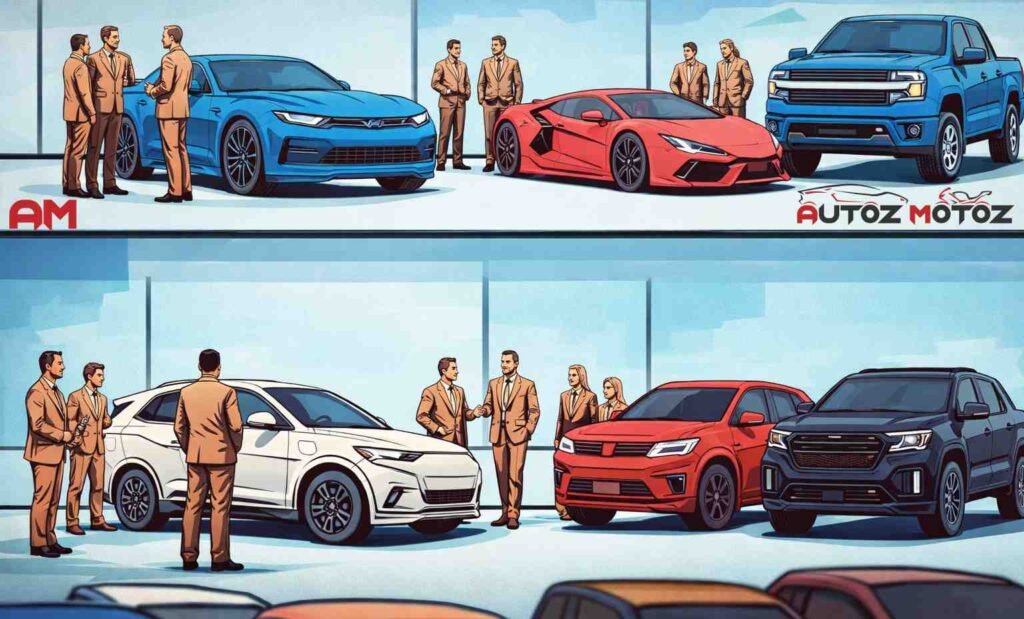
Let’s be real: walking onto a car lot can feel like walking into a trap. Whether you’re buzzing about your first “adult” purchase or you’re on your fifth family SUV, that “am I getting a good deal?” anxiety is totally normal.
We’ve been there. That’s why we built this step-by-step roadmap to help you cut through the noise, skip the sales games, and actually enjoy the feeling of driving your new car home.
JUMP TO :
Whether you are a first-time buyer or a seasoned veteran, navigating the showroom floor can feel like a high-stakes challenge. The pressure of a major investment, combined with the tactics of aggressive sales teams, often makes for a stressful experience.
AutozMotoz, our Buyer’s Guide team lives and breathes the automotive market. We’ve seen every trick in the book and tested every engine on the road. Our mission is simple-to level the playing field. We’re here to arm you with the data, the pure insights, and the negotiating power you need to take back control of the conversation.
Optimization of Asset Acquisition & Lease Structuring
Showroom navigation requires a shift from emotional impulse to technical evaluation. Whether your objective is minimal recurring liability or equity-based ownership, precision in selection is the deciding factor in your long-term fiscal health.
Decision Making
Picking a new car in 2026 feels less like a simple purchase and more like a tech gamble. If you’re leaning toward buying, you’re playing the long game—betting on a hybrid that will actually hold its value when you’re ready to trade it in later. On the flip side, leasing has become the perfect safety net. It lets you drive the latest tech now without worrying about your battery being obsolete by 2029.
This guide cuts through the dealership noise and those sneaky “junk fees” that still pop up despite new transparency laws. Whether you want to own your ride for a decade or just want a “bridge” car until the next big breakthrough, we’re here to make sure you don’t overpay for the privilege.
Buying vs. Leasing
Select Buying if:
- Ownership: Build equity and eliminate recurring debt.
- High Mileage: Annual distance exceeds 15,000 miles.
- Customization: Freedom to modify mechanical/aesthetic specs.
- Long-term Value: Intent to hold asset for 5+ years.
Select Leasing if:
- Cash Flow: Prioritize lowest monthly recurring overhead.
- Tech Cycles: Desire for new battery/safety tech every 36 months.
- Maintenance: Continuous coverage under factory warranty.
- Tax Efficiency: Utilizing business lease write-offs.
Strategic Assessment: 2026 U.S. Automotive Market Data
Do you want a permanent asset or just the right to drive? “Acquisition” is for the driver who wants total control—no mileage police, no modification rules, and a car that eventually belongs to them. But for many, the better play is “User Rights.” Leasing has evolved into a way to “rent” the latest innovations while the industry still figures out the next big jump in battery tech.
We’ve cut through the corporate jargon to explain how these two paths affect your wallet and your freedom. Whether you’re looking to build long-term value or just want the keys to a modern machine without the commitment, here is what you need to know.
Lease vs. Purchase Comparison
| Evaluation Factor | Leasing Option | Buying Option |
|---|---|---|
| Monthly Cost | Lower payments; covers depreciation during the term. | Higher payments; builds toward Full Ownership. |
| Ownership Status | Temporary usage; vehicle is returned at end of term. | Permanent title; you own the asset once paid off. |
| Mileage Limits | Fixed annual limits; excess fees may apply. | Unlimited driving; no overage penalties. |
| Long-term Value | No equity; essentially “renting” the vehicle. | Retains trade-in value and resale potential. |
Mastering Your Budget
Before falling in love with a car, take a hard look at your finances. A common mistake is focusing only on the sticker price while ignoring the “invisible” costs of ownership.
THE 10% RULES :
- Monthly Payment: Aim to spend no more than 10% of your monthly income on the car payment itself.
- The Extras: Factor in another 5% to 10% for taxes, registration, insurance, fuel, and maintenance.
- The Trade-In: Use an online valuation tool to get a realistic price for your current vehicle. Don’t just take the dealer’s first offer—check private-party values and used-car retailers.
Budget Frameworks
| Benchmark | Balanced Baseline | Wealth-Builder |
|---|---|---|
| Initial Equity | 20% Down Payment | 35% Down Payment |
| Debt Duration | 4-Year Maximum | 3-Year Maximum |
| Income Impact | 10% of Gross Pay | 8% of Take-Home Pay |
| TCO Coverage | Standard Maintenance | Full Contingency Fund |
*Total Cost of Ownership includes insurance, fuel, and tech depreciation.
Budget Calibration
MARKET ATP: $48,000
Sustainable acquisition requires looking beyond the monthly installment. To maintain long-term solvency in the 2026 market, apply the 20/4/10 Framework to evaluate total asset viability.
Projected Carry-Costs
- [!] When considering tax and logistics, it’s important to plan for an 8–10% variance between the Manufacturer’s Suggested Retail Price (MSRP) and the final Out-the-Door (OTD) settlement.
- [!] The complexity of ADAS sensor arrays has increased repair costs. This has led to a 15% increase in insurance premiums.
Market Research

In 2026, the car market has hit a “sustainable rhythm.” New-car sales are holding steady at 16 million units, but the real story is the price: the average transaction has plateaued at a steep $50,000.
Strategic Leverage
MARKET: US-REGIONAL DATA
Preparation is your primary shield. Under current CARS Act legal mandates, dealership transparency is non-negotiable—yet your ability to secure favorable terms depends entirely on your pre-market data set.
“A data-backed buyer is functionally immune to showroom theater.”
Buying is a long-term asset play; leasing is a tech hedge. Choose hybrids for the best resale value today.
Ownership builds equity; user rights avoid tech decay. Focus on hybrids to dodge the $50k plateau trap.
Automotive value is now dictated by Software Longevity rather than mechanical hardware. Focus must shift toward system architecture and battery chemistry.
As incentive structures shift, hybrid systems offer the most reliable insulation against ownership costs and energy volatility.
Identify which features are embedded in the hardware versus those requiring recurring subscriptions before settlement.
Success in the current market requires a focus on Capital Preservation. Often, a high-tier certified pre-owned vehicle provides a stronger financial shield than a base-level new arrival.
Obsolescence Risk
Evaluate the interface balance. Tactile controls are currently yielding higher secondary market demand than all-digital dashboards.
Supply Logistics
Component sourcing directly impacts trade-in leverage. Regionally assembled batteries offer better long-term tax-benefit eligibility.
- 10 Best Car Windshield Sun Shade 2025: Protect Your Car
 Shielding your car from the sun’s intensity is essential. Our… Read more: 10 Best Car Windshield Sun Shade 2025: Protect Your Car
 - 10 Best EZ Pass Holder for Motorcycle 2025
 Finding the best EZ Pass holder for your motorcycle can… Read more: 10 Best EZ Pass Holder for Motorcycle 2025
 - 10 Best Motorcycle Chain Lube 2025: Top Picks for Durable Chains
 The Lucas Oil Chain Lube offers a robust solution for… Read more: 10 Best Motorcycle Chain Lube 2025: Top Picks for Durable Chains



Narrow Your Choice
Refine your search: Filter for tech-longevity and battery-health data. This running year is about finding the machine, not just the deal.
Don’t just choose; eliminate. Cut the noise by filtering for 2026 hybrid resale value and “Out-the-Door” price transparency.
Research Parameters
Automotive valuation is now a Digital Infrastructure play. Success is dictated by system longevity and energy efficiency.
Plug-in systems serve as a financial hedge, protecting against energy volatility while maintaining higher resale potential.
Verify which internal systems are inclusive versus those requiring ongoing service fees to remain functional.
Valuation Analysis
Equity preservation requires high-specification assets. In the 2026 cycle, Certified Pre-Owned entries are often providing superior capital protection over new arrivals.
Interface Utility
The ratio between digital screens and physical controls is now a dominant factor in secondary market desirability.
Component Sourcing
Battery assembly location directly impacts future tax eligibility and long-term asset trade-in leverage.
Test Drive Smart
Stress-test the OS latency, engage the ADAS on highways, and feel for smooth hybrid braking transitions.
The Dual-Path Evaluation: Digital Architecture & Kinetic Performance.
Modern acquisition requires more than a standard drive. You must stress-test the synergy between software responsiveness and mechanical integrity.
Assistance Logic
Audit the Active Safety Suite. Interventions must be surgical. If lane-centering or proximity alerts feel erratic, the software lacks the refinement necessary for long-term value.
HMI Responsiveness
Measure Command Latency. Essential ergonomics—thermal control and visibility—must be accessible within one second. High-friction menu diving is a design liability.
Harmonic Isolation
Isolate NVH levels. Cabin silence is the ultimate luxury metric. Listen for motor frequencies and wind shear that indicate compromises in assembly seals.
Regen Linearization
Verify Energy Recovery calibration. The hand-off between regenerative and friction braking must be seamless. Gritty pedal feel suggests sub-par powertrain mapping.
Follows the same route ! Autos vs Moto ?
Get the Best Price
You own the metal. No mileage police, no “junk fees” at the end, and a car that eventually stops costing you monthly.
5.1% – 12% APR is the 2026 norm. Buying is best for Hybrids and Long-haulers.
Financial Leverage: Bottom-Line Anchoring & Inventory Aging.
With median transaction figures approaching $49,800, the MSRP is merely a baseline. Real leverage is found in the “Out-the-Door” (OTD) aggregate—the only figure that prevents predatory interest masking.
Pre-Visit Documentation
Secure an itemized digital quote before physical engagement. Current market tactics often involve “digital protection” surcharges. If a transparent OTD breakdown is withheld, terminate the dialogue immediately.
Segmented Negotiation
Isolate the Vehicle Sales Price. Dealers often conflate trade-ins and financing into a “bundled” payment to obscure margins. Lock the unit’s net price before introducing secondary variables.
Inventory Flooring Logistics
Analyze “Days on Lot” metrics. Units exceeding 60 days incur significant interest-carry costs. These aging assets represent the highest probability for aggressive discounts below retail price.
Scrutinize the Destination Logistics Fee. While this fixed cost is mandatory, its recent escalation can be utilized as a psychological pivot point to demand a reduction in the primary vehicle margin.
It’s a 36-month subscription to the latest screens. You’re paying for the “new” and dodging the “old.”
Lowest monthly payment, but you walk away with zero equity. Best for EVs and Tech-junkies.
Acquisition Authority: Capital Outlay Anchoring & Carry-Cost Arbitrage.
With 2026 transaction averages exceeding $49,000, the sticker price is merely a baseline suggestion. True leverage is found by isolating the aggregate total from interest padding.
Remote Disclosure Verification
Secure an itemized digital breakdown before physical engagement. Current industry trends often hide “security subscriptions” or “logistics surcharges.” If a transparent total is withheld, cease negotiations immediately.
Deconstructed Negotiation
Isolate the Net Asset Value. Avoid “composite monthly bills” which camouflage profit points. Finalize the unit’s base cost before integrating trade-ins or external credit lines.
Holding Cost Analytics
Monitor the “Inventory Aging” cycle. Vehicles in stock beyond 60 days accumulate heavy internal interest. These stagnant assets are primary targets for adjustments below the manufacturer’s suggested price.
Verify the Freight & Delivery Surcharge. While this line item is mandatory, its recent inflation serves as a powerful psychological lever to negotiate a reduction in the primary vehicle sales margin.
- Will Unleaded 88 Damage My Car?
 Key Takeaways Unleaded 88, also known as E15, contains 15%… Read more: Will Unleaded 88 Damage My Car?
 - Can You Use Windex On Car Windows?
 Key Takeaways You can use Windex on car windows. Just… Read more: Can You Use Windex On Car Windows?
 - Can You Jump A Car in The Rain?
 Key Takeaways Is it safe to jump start a car… Read more: Can You Jump A Car in The Rain?


Close the Deal
| STEP | ACTION | WHY MATTERS |
|---|---|---|
| OTD Audit | Demand a line-item Out-the-Door price. | Prevents “price-packing” in the final 5 minutes of the deal. |
| CARS Compliance | Check for “Junk Fees” (e.g., bogus nitrogen or etching). | Under 2026 FTC rules, these are strictly illegal and non-negotiable. |
| Bridge Check | Confirm your trade-in is valued as a Hybrid/Asset. | Ensures you aren’t being lowballed on high current market demand. |
Contract Diagnostics
STATUS: ENFORCED
Securing an agreement requires a Technical Line-Audit. While modern regulations mandate transparency, discretionary surcharges frequently mask themselves as digital upgrades. Validate all metrics against these verified benchmarks.
-
01 / FISCAL
Statutory Sales Tax
State-regulated percentage. Note: Trade-in equity reduces this liability in select jurisdictions.
-
02 / AGENCY
Licensing & Registration
Verifiable DMV procurement costs for plates and title assignment.
-
03 / ADMIN
Regulatory Doc Fees
Capped by state law in 17+ markets. Verified ceilings: NY/TX ~$260, CA $85.
-
STRIKE / PROFIT
Market Adjustments
Arbitrary dealer premiums. With current inventory normalization, these should be negotiated to zero.
-
STRIKE / MARKUP
Serialized Etching
High-margin dealer add-on. Independent security solutions are available at a 90% cost reduction.
-
STRIKE / OVERLAP
PDI & Delivery Prep
Manufacturer-reimbursed costs. Charging the consumer for “preparation” constitutes double-billing.
LUXURY , SPEED & COMFORTNESS
Take Delivery
Demand a screen-check of the OS version. In 2026, ensure all Over-the-Air (OTA) updates are current so you don’t drive off with “Day 1” bugs.
For Hybrids/EVs, ask for the diagnostic printout. A new 2026 vehicle should show an SoH of 98-100%. If it’s lower, the car sat on the lot too long.
Verify that the Total Price on your final paperwork matches the initial quote exactly. Legally, dealers can no longer add “delivery prep” fees at the last second.
Delivery Diagnostics
STATUS: FINAL GATEWAY
In the 2026 market, “Delivery Day” is your last point of leverage. Once you drive off, the burden of proof for defects shifts to you. Execute this **Systemic Audit** before signing.
- Validate OS Firmware is the current 2026 production version.
- Verify Wireless Protocol Handshakes (CarPlay/Android Auto) for stability.
- Authenticate the Mobile Command App and test remote sequences.
- Inspect Panel Alignment (specifically charging port and tailgate tolerances).
- Inventory Charging Hardware (NACS adapters) in the trunk.
- Conduct a “Rail Dust” Sweep under natural lighting.
“AutozMotoz : Passionate for Automotive Items”
- 2026 Audit: 10 Best Car Diagnostic Scanners (ECU Verified)
 Specifically, a tool’s worth is measured by its performance against… Read more: 2026 Audit: 10 Best Car Diagnostic Scanners (ECU Verified)
 - 2026 Chevrolet Equinox ACTIV AWD Review: What They Don’t Tell You
 Look, I’ll be straight with you from the jump. The… Read more: 2026 Chevrolet Equinox ACTIV AWD Review: What They Don’t Tell You
 - 2026 Tesla Roadster | What We Know About It
 “Welcome back, gearheads! Today we unveil the 2026 Tesla Roadster—an… Read more: 2026 Tesla Roadster | What We Know About It

Money is only a tool. It will take you wherever you wish, but it will not replace you as the driver.
Frequently Asked Questions
How does the 2026 CARS Act protect me from hidden dealership fees?
The California Combating Auto Retail Scams (CARS) Act, effective October 2026, mandates that dealers must disclose the “Total Price” of a vehicle in all advertisements and in their first communication with you. It specifically prohibits “junk fees” for valueless add-ons, such as nitrogen-filled tires with low purity or service contracts for maintenance that your vehicle doesn’t require (like oil changes for electric vehicles).
Is the “20/4/10 Rule” still the best way to budget for a car?
Yes, it remains the most reliable strategy for financial durability. To follow this rule, you should provide a 20% down payment to maintain equity, limit your financing term to 4 years (48 months) to reduce interest, and ensure your total monthly transportation costs (including insurance and fuel/charging) do not exceed 10% of your gross monthly income.
Why is leasing considered “future-proofing” for Electric Vehicles (EVs) right now?
With EV battery technology—such as solid-state prototypes and 800-volt architectures—evolving rapidly in 2026, new models can suffer from “technological obsolescence.” Leasing allows you to drive the latest tech for 2–3 years and return the vehicle before its resale value is impacted by the next generation of battery breakthroughs.
Does a used car purchase come with a “cooling-off” period?
Under 2026 regulations, used vehicle purchases under $50,000 now include a mandatory 3-day or 400-mile right to cancel. This cooling-off period allows you to return the car and cancel the contract if you discover undisclosed mechanical issues or simply change your mind, providing a safety net that was previously only available through high-end retailers.
Which has better resale value: a Hybrid or a pure Electric Vehicle?
In the current 2026 secondary market, Plug-in Hybrids (PHEVs) typically maintain a 12% higher resale premium than pure EVs. This is largely because Hybrids are less susceptible to sudden shifts in charging infrastructure and offer more flexibility for long-distance travel, making them a “safer” equity investment for long-term owners.
EDITOR’S TALK
CARS Act Compliance
Effective Oct 1, 2026: Mandatory 3-day/400-mile return policy for used vehicles under $50k. No questions asked. This is your primary shield against “lemons” and hidden dealership fees.
NACS Charging Standard
Verify native SAE J3400 (NACS) hardware. 2026 is the year of “adapter-free” durability. Avoid CCS1 hardware unless a significant resale discount offsets the rapid obsolescence.
The 20/4/10 Rule
The durability framework: 20% Down, 4-Year Term, 10% Income Cap (including insurance/charging). If the math fails, the asset becomes a liability.
OUR BLOG POSTS ↓

Technical precision in motorcycles, cars, and automotive gear is established by Nahid Hassan through rigorous evaluation. Performance-driven reviews and high-value affiliate insights are consistently curated at AutoZMotoZ to ensure reader trust. Absolute integrity is maintained in every analysis, with a focus on original and human-verified data.