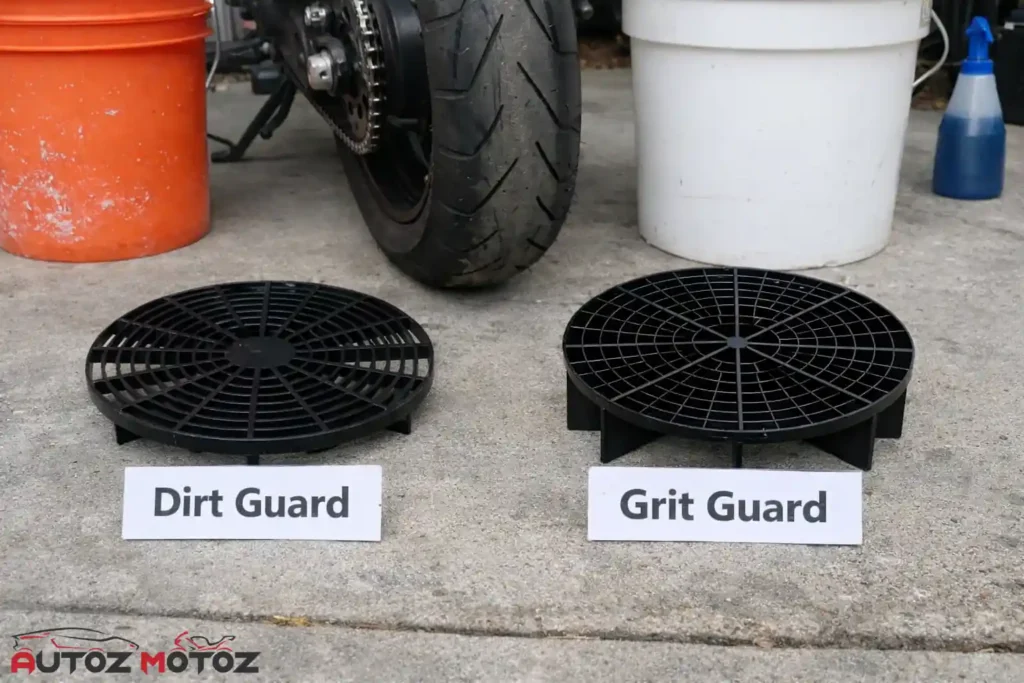
If you’ve started researching proper motorcycle washing technique, you’ve almost certainly come across both dirt guards and grit guards. They look similar, they sit in the same place in your wash bucket, and they solve the same core problem — but they do it differently, and the difference matters depending on how often you ride and how much you care about long-term paint condition.
Most riders don’t need both. A grit guard offers better debris control and mitt cleaning, making it the safer choice for protecting motorcycle paint—especially for frequent washing.
The Problem Both Products Solve
During a proper two-bucket wash, your rinse bucket collects the dirty water you use to clean your mitt between passes. Without anything at the bottom of that bucket, the grit, dust, and road debris you just removed from your bike floats freely in the water. Every time you dip your mitt in to rinse it, there’s a real chance you’re picking that debris back up — and then dragging it across your paint on the next stroke.
Both dirt guards and grit guards are designed to keep that debris out of contact with your mitt. The difference is in how they control and isolate that debris during the wash.
What a Dirt Guard Does
A dirt guard is typically a flat or slightly raised plastic disc that sits at the bottom of your bucket. Its job is passive — it acts as a physical separator between the settled grit on the bottom of the bucket and the water above it.
When you rinse your mitt in the bucket, debris falls through or around the guard and settles below it. The guard keeps the water surface cleaner than it would be without one, reducing how much loose grit your mitt can pick back up.
Harbor Freight sells a well-known budget version that riders have used reliably for years. It’s not sophisticated, but it genuinely reduces the amount of dirt re-introduced to your wash mitt during a session.
What it does well
It separates dirt well for the price, making it a solid budget option.
Where it falls short
It doesn’t actually help clean your mitt. Agitation in water is still required to release debris, allowing some particles to float back into contact range.
What a Grit Guard Does
A grit guard takes the concept further. Instead of a flat disc, a grit guard has a raised grid surface — typically divided into four quadrants — that sits above the bottom of the bucket on a rim that keeps it elevated.
The grid does two things the flat dirt guard doesn’t. First, it gives you a surface to rub your mitt against, which physically agitates and releases trapped debris from the fibers more effectively than water alone. Second, the raised design creates more physical separation between the debris zone at the bottom and the usable water above. Grit released from your mitt falls down through the grid and stays below it.
The Grit Guard brand — the company that popularized this design — is the most widely used version in the US, and it fits most standard five-gallon buckets. Several other brands make compatible versions at lower price points.
What it does well
Active mitt cleaning is facilitated alongside improved debris containment. Through a genuine rubbing action, more dirt is successfully extracted from mitt fibers between passes.
Where it falls short
It costs more than a basic dirt guard. Within a budget-focused setup, this component is not always viewed as the primary priority.
Side-by-Side Comparison
| Feature | Dirt Guard | Grit Guard |
|---|---|---|
| Price range | $5 – $8 | $10 – $15 |
| Debris containment | Passive | Active + passive |
| Mitt cleaning ability | Minimal | Moderate to strong |
| Design complexity | Simple flat disc | Raised grid with quadrants |
| Best for | Budget builds, casual riders | Frequent washers, paint-conscious owners |
| Durability | Moderate | Generally stronger |
| Widely available | Yes (Harbor Freight, Amazon) | Yes (Amazon, auto parts stores) |
Does a Dirt Guard Actually Work?
Yes — within its limits, and those limits are worth being clear about.
A dirt guard meaningfully reduces the amount of debris that gets reintroduced to your mitt versus washing with a plain bucket. For a rider who washes every few weeks under normal conditions, it’s a legitimate upgrade that costs almost nothing.
What it does not do is guarantee clean water or fully clean your mitt. If you’re washing a very dirty bike, agitating your mitt in a bucket with only a flat guard at the bottom will still result in some debris floating back up to mitt level. Your technique and how frequently you change or rinse the bucket water still matters.
Does a Grit Guard Fully Solve the Problem?
More effectively than a dirt guard, but still not perfectly. A grit guard significantly reduces debris re-contact and gives you an active cleaning surface for your mitt — both of which are real advantages. But no passive system eliminates the need for correct technique. If you’re using dirty water, not rinsing often enough, or applying too much pressure, a grit guard won’t compensate for that.
The two-bucket method with a grit guard in the rinse bucket is the most widely recommended setup among detailers in the US, and for good reason — it combines mechanical mitt cleaning with physical debris separation in a simple, low-cost system.
Which One Should You Buy?
Choose a dirt guard if:
- You’re building a first kit on a tight budget
- You wash your bike occasionally — once or twice a month or less
- You want an improvement over plain bucket washing without spending much
- You’re still learning proper two-bucket technique and want to start simple
Choose a grit guard if:
- You wash frequently — weekly or after most rides
- You’re working with a dark-colored bike where swirl marks show easily
- You’ve already built the basic kit and want to optimize it
- You care about maximizing paint protection over the long term
Use both if: Some riders put a grit guard in the rinse bucket for active mitt cleaning and a dirt guard in the wash bucket purely for settling any debris that gets into the soapy water. It’s a reasonable approach if you already have both, but it’s not necessary for most riders.
Where These Fit in a Full Wash Setup
Neither a dirt guard nor a grit guard works in isolation. They’re one component of a proper two-bucket wash system that also includes a microfiber wash mitt, pH-neutral soap, separate drying towels, and correct top-to-bottom washing technique.
If you’re putting together a complete kit from scratch, our under-$50 motorcycle cleaning tool guide walks through everything you need and what order to prioritize it in.
Frequently Asked Questions
Q: Can I use a grit guard in a regular five-gallon bucket?
A: Yes. The standard Grit Guard insert is sized to fit most five-gallon buckets sold in the US. Measure your bucket’s inner diameter before ordering if you’re using an unusual brand.
Q: Is the Grit Guard brand worth the price over generic alternatives?
A: The original Grit Guard is well-built and fits reliably. Several Amazon alternatives work comparably at lower cost — read reviews specifically about fit, since the main failure point for generic versions is not fitting the bucket securely.
Q: Do I need one in both buckets?
A: Most riders put the grit guard only in the rinse bucket, where the heaviest debris accumulates. The wash bucket stays cleaner by comparison, though some detail-oriented riders use a guard in both.
Q: How do I clean a grit guard?
A: Remove it from the bucket and rinse with a hose. Occasionally scrub with a soft brush to clear debris from the grid channels. They’re simple to maintain.
Q: Will either of these scratch my mitt?
A: No. Both are made from smooth plastic that is softer than microfiber. Rubbing your mitt against a grit guard’s grid surface will not damage the fibers.
Conclusion
Both options improve your wash process — but they don’t perform at the same level.The dirt guard is the right starting point if budget is your primary concern. The grit guard is the smarter long-term choice if you wash regularly and want the best paint protection a simple bucket insert can provide.
Either one is a meaningful upgrade over washing with a plain bucket — and either one, combined with correct technique and a microfiber mitt, will protect your paint far better than most riders currently manage.

Technical precision in motorcycles, cars, and automotive gear is established by Nahid Hassan through rigorous evaluation. Performance-driven reviews and high-value affiliate insights are consistently curated at AutoZMotoZ to ensure reader trust. Absolute integrity is maintained in every analysis, with a focus on original and human-verified data.