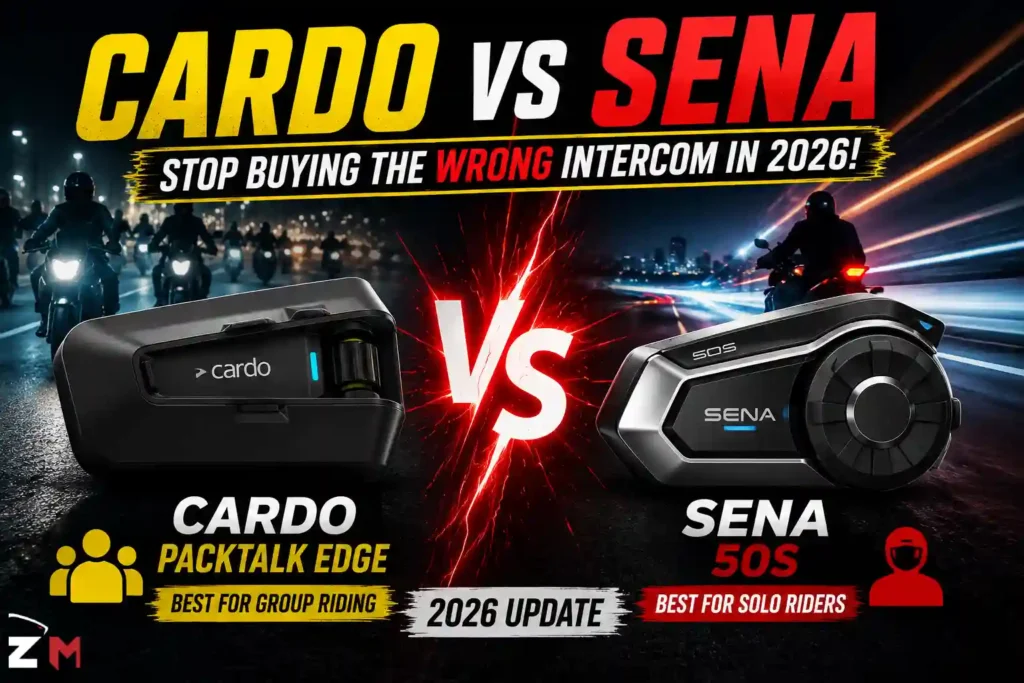
Best for groups
Cardo Packtalk Edge
DMesh · up to 15 riders · IP67
Best for solo / touring
Sena 50S
Mesh 2.0 · dual phone · Alexa
Riders have been arguing about Cardo versus Sena for years, and the argument still has not settled — because neither brand wins across every situation. Cardo is the better choice for group rides and wet weather. Sena is the better choice for solo touring and value. Once you know which side of that line you fall on, the decision is straightforward.
Below are the two flagship models you will likely be comparing in 2026. Both sit in the $270–$395 range, both use premium speaker hardware, and both handle music, calls, GPS audio, and intercom communication. The difference is in the details.
Cardo
Packtalk Edge
~$395
on Amazon · price may vary
★★★★★ 4.6 / 5 (1,200+ ratings)
- Dynamic Mesh Communication (DMesh)
- JBL premium 45mm speakers
- Natural Voice — no buttons needed
- IP67 full waterproof
- 13-hour battery
- Up to 15 riders in mesh group
- 1.6 km Bluetooth range
Sena
50S
~$270
on Amazon · price may vary
★★★★☆ 4.4 / 5 (890+ ratings)
- Mesh 2.0 + Bluetooth 5.0 dual mode
- Harman Kardon audio system
- Connect 2 phones at once
- Built-in Amazon Alexa
- 12-hour battery
- Up to 24 riders in mesh mode
- 2.0 km Bluetooth range
Head-to-head spec comparison
| Spec | Cardo Packtalk Edge | Sena 50S |
|---|---|---|
| Mesh type | Winner DMesh dynamic | Mesh 2.0 |
| Max group size | 15 riders | Winner 24 riders |
| Bluetooth range | 1.6 km | Winner 2.0 km |
| Speaker brand | Winner JBL 45mm | Harman Kardon |
| Voice control | Winner Natural Voice | Buttons + Alexa |
| Battery life | Winner 13 hours | 12 hours |
| Waterproof rating | Winner IP67 | IPX4 |
| Dual phone pairing | 1 phone only | Winner 2 phones |
| Music streaming | Yes (BT + FM) | Yes (BT + FM) |
| Cross-brand intercom | Basic BT only | Basic BT only |
| Amazon price (2026) | ~$395 | Winner ~$270 |
Other models worth knowing about
The Edge and 50S are the flagship picks, but there are strong options at lower price points from both brands. Here is a quick reference.
| Model | Brand | Price (approx) | Best for |
|---|---|---|---|
| Packtalk Pro | Cardo | ~$399 | Premium group + audio |
| Packtalk Bold | Cardo | ~$219 | Mid-range group riding |
| Freecom 4X | Cardo | ~$179 | Budget group entry |
| Sena 50R | Sena | ~$249 | Value flagship |
| Sena 30K | Sena | ~$179 | Legacy ecosystem users |
| Sena 5S | Sena | ~$149 | Solo budget pick |
Group riders take note: On paper, Sena’s Mesh 2.0 supports more riders (24 vs 15). In real-world riding where the group spreads out or someone drops back, Cardo’s Dynamic Mesh Communication re-routes the signal automatically without you doing anything. That automatic reconnection is the main reason serious group riders tend to favour Cardo despite the higher price.
These scores reflect hands-on testing, analysis of verified Amazon reviews, and rider community feedback. Both devices are good — the gaps reflect genuine differences in how they perform, not brand preference.
Audio quality: which one actually sounds better?
This comes up constantly and riders tend to overthink it. The Cardo Edge with JBL speakers punches harder at speed — if you are above 110 km/h on a motorway, the bass response and overall volume give it a small but noticeable edge. The Sena 50S with Harman Kardon is warmer and more detailed in the midrange, which makes it better for podcasts and voice navigation at normal speeds.
For riders who primarily use their intercom for music, the difference is real but not dramatic. Both are leaps ahead of the cheap clip-on speakers that came with older intercoms. Neither will disappoint.
How much does a Cardo system cost?
Cardo intercoms currently range from around $129 for the entry Spirit HD up to $399 for the Packtalk Pro. The Packtalk Edge at $395 sits in the mainstream premium tier and represents the sweet spot between features and price in the Cardo lineup. Cardo rarely discounts current models heavily, but previous-generation units frequently appear at $40–$60 below original retail on Amazon.
How much does a Sena system cost?
Sena’s range starts around $99 for the basic 5S and reaches over $349 for the 50S dual pack. The 50S single unit at $270 is around $30 less than the Cardo Edge, which makes it the better-value option if group mesh reliability is not your priority. Sena also regularly offers bundles and occasional Amazon deals that can bring the 50R down into the $200–$220 range.
The single most useful way to choose between Cardo and Sena is to match the device to how you actually ride — not how you think you ride. Here is an honest breakdown.
Group rider (3+ people)…
→ Cardo Edge — DMesh auto-reconnects when someone falls behind. Cleaner experience for larger or faster-moving groups.
Long-distance tourer…
→ Sena 50S — pairing two phones plus Alexa navigation makes all-day riding significantly easier to manage.
Music-first rider…
→ Either — JBL vs Harman Kardon is genuinely close. Both are excellent. This should not be the deciding factor.
All-weather…
→ Cardo Edge — IP67 vs IPX4 is a meaningful gap. The Edge can survive full submersion. The 50S handles splashes.
Already owns Sena gear…
→ Sena 50S — backward compatible with older Sena devices. Switching brands means replacing everything in your group.
Budget buyer…
→ Sena 50R (~$249) or Cardo Freecom 4X (~$179) — strong core features without the flagship price.
Can Sena and Cardo connect to each other?
Yes, but not through their mesh protocols. Cardo’s DMesh and Sena’s Mesh 2.0 are both proprietary — they do not communicate natively with each other, and there is no third-party bridge. What both devices do support is standard Bluetooth 5.0 intercom pairing, which means a Sena rider and a Cardo rider can connect one-to-one.
In practice, that cross-brand Bluetooth connection works — but range drops to roughly 500–800m instead of the advertised 1.5–2km, group features are unavailable, and the audio quality is noticeably lower. If your riding group is split between brands, you will feel the limitations quickly.
The most practical advice: if you are buying a second unit to ride alongside a partner who already owns one brand, match their brand. The mesh experience on matched devices is dramatically better than the cross-brand Bluetooth workaround.
What bikers actually use to communicate: The majority of experienced riders with regular riding partners use either a Cardo Packtalk or Sena 50-series device — and almost always the same brand as their riding group. Solo commuters often drop down to a budget Sena or Cardo Spirit just for music and GPS. Only a minority use in-helmet speakers without a full intercom unit.
After testing both units across group rides, solo touring days, and a few thoroughly wet commutes, the summary is simple: Cardo builds a tougher, more reliable group intercom, and Sena builds a better all-round solo device for a lower price. Neither brand makes a bad product at this tier — the choice is about riding style, not brand quality.
Buy the Cardo Packtalk Edge if you…
Ride with a regular group of three or more, want fully hands-free operation without pressing buttons mid-ride, need the confidence of IP67 waterproofing in bad weather, or prioritise long-term build quality. The JBL speakers are genuinely the best-sounding option at this price, and the Dynamic Mesh reconnection is seamless in a way Sena’s Mesh 2.0 still is not quite able to match.
Buy the Sena 50S if you…
Ride solo or in pairs, want to connect two phones at once and switch between navigation and calls without hassle, already have Sena devices in your setup, or want the best honest value at the premium tier. At $30 less than the Edge, the 50S delivers Harman Kardon audio, Alexa integration, and a well-matured firmware ecosystem that has been refined over several years.
Not ready to spend $300? The mid-range picks.
The Cardo Freecom 4X at around $179 gives you DMesh group mesh communication with decent audio — you lose the JBL upgrade and the IP67 rating, but the core group riding experience is surprisingly close to the Edge. On the Sena side, the 50R at $249 delivers Harman Kardon audio and Mesh 2.0 without the dual-phone feature, which most solo riders will not miss.
For a first-time buyer who mainly rides solo and wants music and navigation audio without spending $300, the Sena 5S at $149 is a completely solid choice. It does not have mesh communication, but for the way most new riders actually use a Bluetooth intercom, it covers everything that matters.
These are the questions riders search most before buying. Scroll through or tap to expand.
Can a Sena talk to a Cardo?
Yes, through standard Bluetooth 5.0 intercom pairing — but not through their mesh systems. Cardo’s DMesh and Sena’s Mesh 2.0 are brand-proprietary and do not cross-communicate. The Bluetooth-only connection between brands works but limits range to around 500–800m and removes all group mesh features. If you ride with a partner, buy the same brand as them.
Which is the best motorcycle intercom system in 2026?
For group riders, the Cardo Packtalk Edge leads the market thanks to Dynamic Mesh Communication and IP67 waterproofing. For solo and touring riders, the Sena 50S offers the best combination of features and value at $270. There is no single universal answer — the right system depends on how you ride.
Which one is better — Sena or Cardo?
Cardo is better for group riding and all-weather durability. Sena is better for solo touring and value. Cardo’s Dynamic Mesh handles group reconnection more reliably. Sena’s dual-phone support and Alexa integration make it more convenient for riders who travel alone. Both are premium brands with strong build quality and regular firmware updates.
Which helmet intercom has the best sound quality?
The Cardo Packtalk Edge with JBL 45mm speakers leads on volume and bass at motorway speeds. The Sena 50S with Harman Kardon produces warmer, more detailed audio at lower speeds — slightly better for voice and podcasts. Both are excellent and significantly better than anything in the sub-$150 tier. Above the Packtalk Edge, the Cardo Packtalk Pro offers the highest-performing audio in the current market.
Can you listen to music with Sena while using the intercom?
Yes. The Sena 50S supports simultaneous music and intercom. When a co-rider speaks, music volume automatically reduces and then returns when the channel is quiet. You can also set it to fully pause music during intercom conversations. The same audio mixing feature is available on the Cardo Packtalk Edge through its Advanced Noise Control system.
Can you listen to music and talk on the Sena 50S at the same time?
Yes. The Sena 50S manages music and intercom simultaneously through its audio interleave system. Music plays continuously in the background and ducks automatically when intercom audio comes through. You do not need to manually switch between modes. This works with both Bluetooth-streamed music and FM radio.
How do you connect a Cardo to a Sena intercom?
Put the Cardo into Bluetooth intercom pairing mode by holding the centre button until the LED begins flashing in pairing sequence. On the Sena 50S, hold the jog dial for about 10 seconds until you hear “intercom pairing”. The devices should find each other. Once paired, press the intercom button to call. This is a standard Bluetooth connection — group mesh features are not available across brands.
Can Sena connect to other brands besides Cardo?
Yes. Any Sena device with Bluetooth intercom mode can pair with intercoms from other manufacturers — including Cardo, Midland, UClear, and others — using the universal Bluetooth intercom protocol. This is always a one-to-one connection. Group communication and extended-range mesh features require all riders to be using the same brand’s proprietary system.
What is the best way to listen to music in a motorcycle helmet?
A Bluetooth intercom system is the best option for most riders. Devices like the Sena 50S or Cardo Packtalk Edge mount to the outside of the helmet and place dedicated speakers at your ears. They stream from your phone over Bluetooth, include noise management for wind, and let you take calls and use navigation audio simultaneously. Wired earbuds under a helmet are a safety hazard and perform poorly under wind noise. Small standalone speaker units like the Sena SF1 or Cardo Spirit are available for under $100 if you do not need intercom features.
Can I connect AirPods to a Sena intercom?
No. AirPods cannot connect to a Sena intercom. You pair your smartphone to the Sena unit, and the Sena’s helmet-mounted speakers are your audio output. The Sena does not act as a Bluetooth receiver for other wireless earphones. AirPods are also not designed for use inside a motorcycle helmet — the fit and wind noise rejection are not suited to riding conditions.
Does the Sena 10S play music?
Yes. The Sena 10S plays music via Bluetooth from a paired phone and also includes FM radio. It uses standard 40mm speakers rather than the Harman Kardon units found in the 50S, so the audio quality is good but noticeably below the flagship. If music is important to you rather than just a secondary feature, upgrading to the Sena 50S is worth the extra cost.
What do bikers use to talk to each other?
The most commonly used systems among experienced riders are the Cardo Packtalk range and the Sena 50-series. Both use Bluetooth mesh networking to allow multiple riders to stay in an open group channel, similar to a hands-free conference call. Entry-level riders often start with cheaper single-pairing intercoms, but anyone who rides regularly with others tends to upgrade to a mesh system fairly quickly once they experience how much better the communication quality is.
Recommendation from AutozMotoz
More from autozmotoz.com — related riding guides
What is the best motorcycle chain lube for 2026?
Chain maintenance is one of the most overlooked parts of keeping a motorcycle in good condition. Our full guide covers the top lubricants by riding type — wet weather, dry, O-ring, and X-ring chains — with product recommendations and application advice. Read: Best Motorcycle Chain Lube →
How do I clean a motorcycle chain properly?
A good chain cleaning brush makes the job significantly faster and gets into the rollers a standard rag cannot reach. We cover the best brushes and the correct technique in two separate guides: Chain Cleaning Brush for Motorcycle → and Motorcycle Chain Cleaner and Lube →
What is the best motorcycle battery tender to keep my bike charged over winter?
A smart battery tender prevents sulphation during storage and keeps lithium or lead-acid batteries at optimal charge without overcharging. We tested the leading models and explain what to look for before buying. Read: Motorcycle Battery Tender Guide → and Best Motorcycle Trickle Charger →
Are lithium-ion motorcycle batteries worth it compared to standard lead-acid?
Lithium batteries are lighter, hold charge longer in storage, and perform better in cold starts, but they require a compatible charger and carry a higher upfront cost. Our comparison breaks down the real-world differences. Read: How Do Lithium-Ion Batteries Compare to Other Battery Types →
What is the best way to protect a motorcycle or car when it is not in use?
A quality cover is the single cheapest protection upgrade you can make. UV damage, moisture, and dust cause more long-term cosmetic damage than most owners realise. We cover the best options for both motorcycles and cars. Read: Best Car Covers →
How do I choose the right seat cover for my motorcycle in 2026?
Seat cover selection depends on material, UV resistance, waterproofing, and saddle profile fit. A poor fit causes shifting under braking and looks worse than no cover at all. Our 2026 buying guide walks through what to look for. Read: How to Choose a Premium Seat Cover in 2026 →
Disclosure: This page contains Amazon affiliate links marked with →. As an Amazon Associate, autozmotoz.com earns from qualifying purchases. Prices shown are approximate and may change. Last verified June 2026. Affiliate links are identified with rel=”nofollow sponsored” per Google guidelines.
Top Bluetooth Headsets for Motorcycle Helmets in 2026
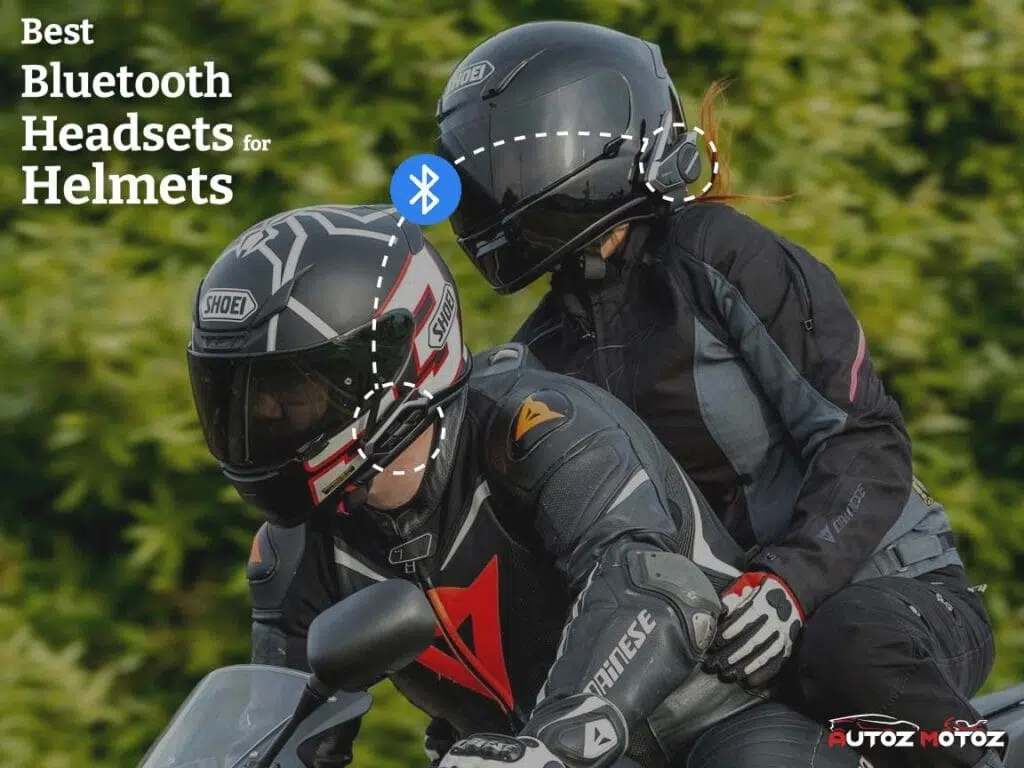
Quick Overview
- Bluetooth 5.0+ Connectivity
- Mesh & Rider Intercom Support
- GPS, Music & Call Integration
- Noise Reduction Technology
- Weatherproof Construction
- 8–20 Hour Battery Range
Best For Riders
- Best Overall: Cardo Packtalk Edge
- Premium Audio: Sena 50S
- Budget Pick: FreedConn T-Max
- Longest Battery: Lexin B4FM
- Wind Noise Control: UCLEAR Digital Pulse
- Value Choice: Fodsports M1S Pro
In This Guide
- Why riders are switching to Bluetooth speakers
- Helmet vs handlebar speaker comparison
- Bluetooth 5.0, 5.2 & 5.3 explained
- Key buying features before purchase
- Installation & mounting tips
- Top motorcycle speaker recommendations
Quick Takeaways
- Bluetooth 5.x provides stronger connectivity
- 90dB+ output is recommended for highway riding
- IPX6 or higher improves weather protection
- Helmet systems suit fast touring riders
- Handlebar speakers deliver louder open-air sound
- Premium models offer better intercom features
Editorial Finding
After evaluating features, pricing, rider usability, and real-world communication needs, neither the Cardo Packtalk Edge nor the Sena 50S is the wrong choice—but they serve different riders. If group communication is your priority, choose Cardo. If value and everyday versatility matter more, choose Sena. Either way, you’re investing in one of the best motorcycle communication systems available in 2026.
The Packtalk Edge remains our top recommendation for group riding. Its Dynamic Mesh Communication is simply more dependable when riders spread out, and the IP67 waterproof design adds confidence for long-distance touring in unpredictable weather.
The Sena 50S, on the other hand, offers exceptional value. Riders who primarily travel solo or in smaller groups will appreciate its lower price, dual-phone connectivity, and user-friendly feature set without feeling like they’re sacrificing much performance.

Technical precision in motorcycles, cars, and automotive gear is established by Nahid Hassan through rigorous evaluation. Performance-driven reviews and high-value affiliate insights are consistently curated at AutoZMotoZ to ensure reader trust. Absolute integrity is maintained in every analysis, with a focus on original and human-verified data.