

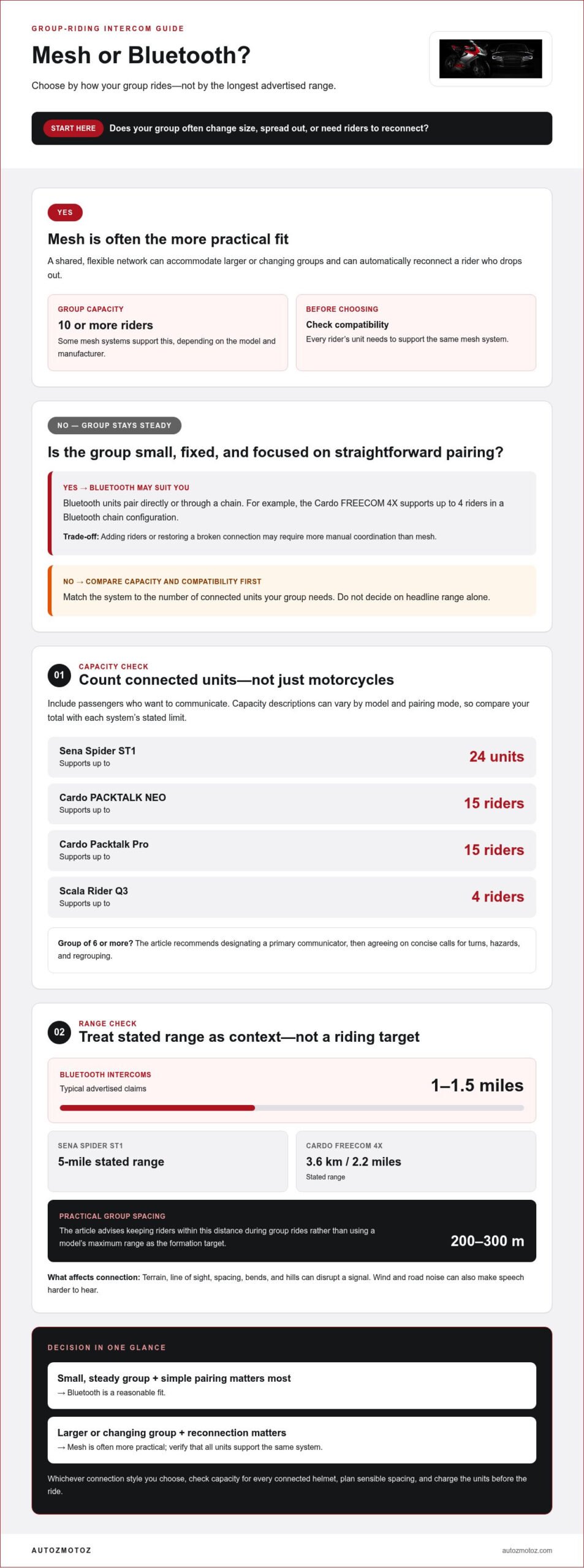
The longest advertised range doesn’t automatically make the best motorcycle intercom for group riding. For a large or changing group, mesh is often the more practical choice: some systems support 10 or more riders and can reconnect a rider who drops out. Bluetooth can still make sense for a smaller, fixed group where straightforward pairing matters more than flexible group connections.
You’re right to look beyond headline range: rider capacity matters only if the intercom fits your helmet and keeps the group connected in the way you ride. This guide compares mesh and Bluetooth, then explains capacity, helmet fit, and useful group features. You’ll finish with a practical way to narrow your options without paying for capabilities your group won’t use.
Key Takeaways
- Choose the connection style around how your group rides: fixed pairings favor simplicity, while a changing group benefits from a network designed to reconnect riders.
- Match rider capacity to your usual group size, and leave room for the occasional extra rider rather than buying on a headline range alone.
- Check how the speakers, microphone, and mounting system work with your helmet before deciding; fit affects everyday comfort and clear communication.
- Compare voice activation and automatic volume control for how easily they let you stay in touch without reaching for the controls.
- Prioritize practical group features, such as multi-rider pairing and clear communication roles, over extras your riding group won’t use.
Mesh vs Bluetooth: Which Technology Works Better in a Group?
On rural roads and highways, compare rider capacity, connection stability, and realistic range, not just advertised distance. Bluetooth suits a smaller, steady group, while mesh can better accommodate larger groups and riders who move in and out of range.
Bluetooth Intercom Connectivity
Bluetooth intercoms pair units directly, then connect riders through a pairing sequence or chain. That can work well for a consistent group: the Cardo FREECOM 4X supports up to 4 riders in a Bluetooth chain configuration. But adding riders or restoring a broken connection may take more manual coordination than with mesh. Cardo and Sena units can pair through standard Bluetooth, although their native mesh features don’t work together.
Mesh Intercom Networks
A mesh network links riders through a shared, flexible connection rather than relying only on one fixed Bluetooth chain. Mesh systems can support groups of 10 or more riders, depending on the model and manufacturer, and can automatically reconnect when a rider drops out. That makes mesh a practical fit for groups that spread out or change formation. Still, check that every rider’s unit supports the same mesh system.
Intercom Range for Group Rides
Range figures need context. Bluetooth motorcycle intercoms typically claim 1-1.5 miles, depending on the antenna, while the Sena Spider ST1 states a 5-mile range. The Cardo Freecom 4X states 3.6 km / 2.2 miles. Those figures aren’t a promise of uninterrupted conversation: terrain, line of sight, and spacing between bikes affect the connection. Rural routes may offer fewer obstacles, but bends and hills can still break the signal.
At highway speeds, keep the group within the system’s practical range and avoid treating a maximum claim as a riding target. Wind and road noise can also make speech harder to hear, so clear audio matters alongside distance. Bluetooth 5 was formally released in December 2016; it provides a maximum data transfer speed of 2 Mbps, four times the communication range of Bluetooth 4.2, and twice its data transfer speed. Those are Bluetooth specification comparisons, not a guarantee of intercom-to-intercom range.
| Option | Pairing and network | Group fit | Range consideration |
|---|---|---|---|
| Bluetooth | Direct pairing or a chain | Smaller, consistent groups; FREECOM 4X supports up to 4 riders | Typical claims are 1-1.5 miles |
| Mesh | Shared network with automatic reconnection | Can suit 10 or more riders, depending on model | Check the model’s stated range and account for terrain |
Choose Bluetooth for a stable, small group, or mesh when rider numbers and changing connections matter more. Whichever you choose, plan to charge the units before your ride.
Mesh networking and rider capacity
Capacity and range vary by model: the Sena Spider ST1 supports up to 24 units, while the Cardo PACKTALK NEO supports up to 15 riders. For comparison, the Scala Rider Q3 supports up to four riders and bike-to-bike communication up to one kilometre.
Choose capacity based on everyone who needs to listen and speak, including passengers, not just the number of motorcycles.
Group-Rider Connection Capacity
Capacity describes how many units can join a conversation, but manufacturers may state that figure differently. Connection capacity varies by intercom model and pairing mode, so check the stated limit before choosing one for a group. Count connected helmets, including a pillion’s, then compare that total with each model’s stated limit.
For larger groups, the Cardo Packtalk Pro supports up to 15 riders. Leave room for a leader or occasional extra rider, and remember that connected-unit limits can differ between brands and connection modes.
Group size also shapes how you organize the ride. For groups of 6 or more riders, designate a primary communicator, so route changes and stops have a clear voice. This keeps multiple riders from talking over one another, especially when speeds change or the group spreads out. Set that role before departure, then agree on concise calls for turns, hazards, and regrouping.
Two-up riding calls for an extra capacity check. The rider and passenger each need a connected unit, so count both if they’ll communicate with the group. For example, a four-rider limit may cover fewer motorcycles when passengers also want to join the conversation.
Rider-to-Rider Range
Range is the distance over which units can maintain communication, not a measure of how many riders can join. The Scala Rider Q3 supports bike-to-bike intercom up to one kilometre. In practice, keep riders within 200-300 m of one another during group rides, rather than using a model’s maximum range as the formation target.
Mesh systems can automatically reconnect when a rider drops out, which helps when the group briefly spreads out. That feature doesn’t replace sensible spacing: hills, bends, or gaps can still disrupt communication. Agree on a regrouping point and keep the primary communicator near the middle of the group.
Before choosing, note the number of motorcycles, passengers, and the largest group you expect to ride with. Compare the total number of connected units with each system’s stated capacity, then plan spacing and communication roles around your route. Higher capacity helps only if everyone can use compatible connection modes and hold a clear conversation at riding speeds.
Universal and helmet-specific intercom systems
For U.S. buyers, intercom prices vary by model, features, and package. Compare single-unit listings with other single units, and multi-unit packs with equivalent packs.
Fit matters as much as the intercom’s network: the speakers, microphone, and mounting hardware need to suit your helmet’s shape and liner.
Universal Intercom Systems
A universal system is designed to fit different helmet models rather than one specific helmet. That flexibility can help when riders in your group wear different helmets, but the clamp or adhesive mount and speaker pockets still need to suit each shell. Before buying, check where the unit sits, whether the liner leaves room for the speakers, and whether the microphone reaches you comfortably.
A helmet-specific system is designed for compatible helmets, which can provide a more integrated fit. The trade-off is less flexibility if you change helmets or share the unit across different shells. Compare the exact helmet model with the intercom’s compatibility information, then check that the speakers sit by your ears without pressing against them.
Do a simple fit check before your first ride: put on the helmet, fasten the chin strap, and test the speaker position and microphone reach. The intercom should not interfere with the helmet’s normal fit or visor movement. Also consider where the control unit sits: a bulky mount can catch on clothing or make it harder to use controls with gloves.
Visor Position and Microphone Placement
Visor position can change the airflow around a full-face helmet, while an open-face or modular design exposes the microphone differently. Wind reaching the mic can compete with speech, especially at highway speeds. For a boom microphone, place it 1-2 cm from the corner of your mouth. Keep it clear of the visor’s closing path and test it with the helmet fully fastened.
Match the microphone style to the helmet opening. A boom mic may suit a helmet with room near the chin, while a wired mic may fit a tighter full-face interior. Either way, check that the padding doesn’t push the mic away from your mouth. Make a short test call before riding and adjust the microphone if your voice sounds muffled.
Phone use adds another fit and control consideration: position the intercom so you can reach its buttons without changing your grip. Check that cables won’t snag on the helmet liner, visor mechanism, or jacket collar. A tidy installation keeps the speakers aligned and helps prevent the hardware from shifting during normal helmet use.
For example, if two riders wear different helmet styles, check the speaker space and microphone route in each helmet separately. Choose a universal unit when flexible mounting suits both; choose a helmet-specific setup when its stated compatibility matches the exact shell. In either case, make sure the visor opens fully and the helmet remains comfortable after installation.
Voice activation and automatic volume control
Hands-free controls can be useful when gloves and traffic leave little room to search for buttons. Compare voice activation, automatic volume adjustment, and microphone noise handling alongside battery life and sound clarity.
Keep spoken intercom commands under 3 seconds. Short instructions are easier to say clearly through a helmet microphone, especially when wind and engine noise compete with your voice. Try the commands while stationary first, then use only the controls you can operate reliably on the road. For example, test a brief request to reconnect or adjust audio before relying on it during a group ride.
Voice activation can reduce the need to reach for a device, but it depends on the system recognizing your speech. Helmet fit, microphone position, and surrounding noise all affect how clearly your voice reaches the mic. Test the setup by speaking at your usual riding volume, then repeat a command with the visor in its normal position. If the device misses words, adjust the microphone before changing how you speak.
Automatic volume control adjusts playback as surrounding sound changes, while microphone noise handling aims to reduce unwanted sounds picked up by the mic. They address different issues: volume adjustment helps you hear audio, while mic noise reduction can make your voice clearer to other riders. Neither eliminates wind or traffic noise. Compare intercom audio at different speeds rather than judging it only in a quiet room.
Battery life matters because voice controls and intercom use still draw power throughout a ride. The Sena Spider ST1 lists 11 hours of battery life, while the Cardo Freecom 4X lists 13 hours. Aim for at least 10 hours of talk time for group riding, and bring a USB power bank and Type-C cable for rides longer than 8 hours.
Compare controls in a practical order: confirm the commands you’ll use, test microphone clarity, then check whether volume adjustments keep navigation and intercom audio audible. Also learn how to adjust the volume manually if voice activation fails. A control you can find by touch is more useful than a long list of commands you won’t remember.
To assess sound quality, focus on clear speech at your usual riding speeds, not just music playback while parked. Ask a riding partner to listen for clipped or muffled words during a short test. Then check whether automatic volume changes feel comfortable and whether commands work without repeated attempts. These checks reveal more than a feature label alone.
Group-riding intercom features
A good group setup is about more than a high rider limit. Clear conversation, easy pairing, useful controls, and features that suit your rides matter just as much.
For 2026, compare the Cardo PACKTALK PRO and PACKTALK NEO, both supporting up to 15 riders, with the Sena Spider ST1, supporting up to 24 units. For a smaller group, the Cardo FREECOM 4X supports up to 4 riders in a Bluetooth chain.
In the United States, put safety first: set controls before moving, don’t handle the device in traffic, and keep audio low enough to hear your surroundings. Rules for audio devices vary by location, so follow the requirements where you ride.
Treat pairing as a group feature to assess, not a chore to leave until departure. Agree on a connection mode, pair the units while parked, and test that every rider can join. Cardo and Sena units can communicate through standard Bluetooth pairing, but their native mesh features aren’t compatible with each other. Mixed-brand groups should account for this distinction when choosing a shared setup.
Conversation controls should match how your group communicates. A primary communicator can call turns and regrouping points, while other riders keep chatter brief. For groups of 6 or more, designate that lead voice before departure. This simple plan can make conversations easier to follow when several riders need to share updates.
Audio features deserve a practical comparison. The Cardo PACKTALK PRO uses 45mm JBL speakers, while the PACKTALK EDGE uses 40mm JBL speakers. Speaker size alone doesn’t establish which sounds better in your helmet, so compare fit and speech clarity. Both models support charging while riding via USB, a useful feature for longer days away from a stop.
Some extras solve specific problems. The PACKTALK PRO includes Crash Detection that can send a rider’s GPS location to a designated contact. The Schuberth S2 SRC has a six-station VHF radio, which offers a different way to communicate than Bluetooth or mesh. An excellent feature on paper still needs to match your group’s habits and equipment.
Build a shortlist around your ride: select a connection type, confirm the group can pair, then compare audio and controls. Add safety-related extras only if they serve a real need. For an independent look at accessory comparisons, compare motorcycle accessories and products before settling on a setup.
Choose a system the whole group can use consistently, not the one with the longest feature list. A quick parked test of pairing, conversation, and controls can reveal problems before the ride begins.
AutozMotoz: Reseñas y comparativas de accesorios y productos automotrices
AutozMotoz publishes reviews and comparisons of automotive accessories and products to help you weigh intercom options against your riding needs. Use these guides when you’ve narrowed your choice to mesh or Bluetooth but still need to compare features, helmet fit, or group communication trade-offs.
For example, a large group may prioritize rider capacity and reconnection, while a smaller crew might care more about straightforward pairing and comfortable controls. A comparison is most useful when you focus on the details that affect your own rides, rather than treating one feature as the deciding factor. That makes it easier to choose equipment with a clear purpose and avoid paying attention to extras that don’t suit your group.
Explore AutozMotoz’s accessory and product reviews and comparisons, or contact AutozMotoz to continue your research.
Make your next intercom choice with a clear purpose
Your next step isn’t to chase every feature. Decide what your group needs on its actual rides: who joins the conversation, how easily everyone can pair, and whether the controls suit your routine. These priorities give you a practical filter for finding the best motorcycle intercom for group riding, without letting a long feature list make the decision for you.
If you’re comparing specific options, AutozMotoz’s reviews and product comparisons can help you weigh what matters. Use them to narrow your shortlist to your riding style and priorities, then choose the system that suits your group.
Explore AutozMotoz’s accessory and product comparisons, and head into your next ride with a choice that fits.
Frequently Asked Questions
What Makes a Great Intercom for Group Riding?
A good group intercom is one your whole crew can operate without distracting the rider. When choosing the best motorcycle intercom for group riding, consider how your group handles route changes, passenger conversations, and unexpected splits. A weekend ride with frequent stops may call for simple controls and easy audio access; a long, spread-out route may put different needs first. Decide how your group communicates before comparing extra features.
Which motorcycle intercoms support mesh networking, and how does mesh compare with Bluetooth?
Mesh options include the Sena Spider ST1 and Cardo PACKTALK NEO, while Bluetooth systems include the Cardo FREECOM 4X. Mesh is designed for group connections that can adapt as riders drop out; Bluetooth pairing commonly links units directly or in a chain. Cardo and Sena units can pair using standard Bluetooth, but their native mesh networks don’t interoperate, so mixed-brand groups should plan their connection method.
Which motorcycle intercoms work with different brands and existing Bluetooth headsets?
Cardo and Sena units can communicate through standard Bluetooth pairing, although their native mesh systems aren’t compatible with each other. An existing Bluetooth headset may join only if its pairing mode supports the group’s connection method. For a mixed setup, pair one device at a time while stationary, then test whether each rider can hear and respond before relying on it during a ride.
Which intercoms fit different helmet types and are easiest to install?
Universal kits are designed for different helmets, while helmet-specific systems are made for compatible shells. If your group uses different gear, compare the mounting options on each helmet rather than assuming one installation will suit everyone. Check speaker pockets, liner clearance, and cable routing, then wear each helmet as usual to assess pressure points. A tidy fit should leave the visor and chin strap working as intended.
How do riders pair, configure, and troubleshoot a motorcycle group intercom?
Pair and test the system before the group sets off. Start with charged units, follow each model’s pairing steps, and connect riders in the intended order. Test intercom audio, phone audio, and navigation separately to help identify the source of any problem. If a unit won’t reconnect, stop safely, check its selected mode, and try pairing again rather than troubleshooting while moving.
What safety and legal rules apply to using motorcycle intercoms while riding in the United States?
Keep riders within range of one another, designate a primary communicator for larger groups, and use concise calls for turns, hazards, and regrouping. Riders should always check specific state and local laws regarding the use of in-helmet speakers and communication devices while operating a motorcycle on public roads.
What are the prices of top motorcycle intercom systems in the United States?
Prices for top motorcycle intercom systems generally range from $150 to $200 for entry-level single units, while advanced mesh-enabled dual packs or flagship models from brands like Cardo and Sena typically cost between $300 and $600 depending on the specific features and bundled accessories included.