
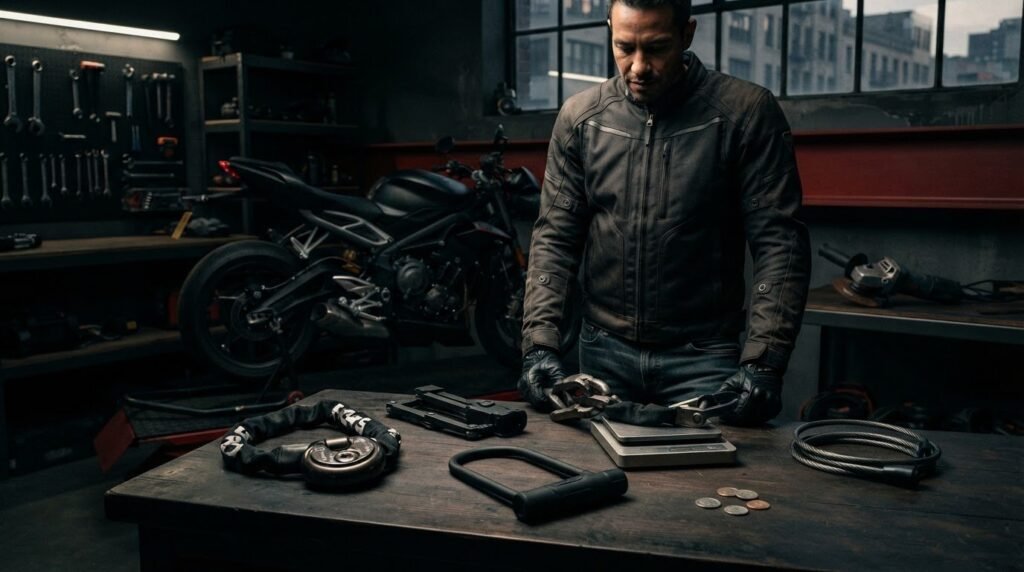
The toughest-looking lock isn’t automatically the hardest to attack. For angle-grinder resistance, Sold Secure Motorcycle Diamond is a useful benchmark: its testing includes a 90-second angle-grinder attack, and the Oxford Beast chain is rated Motorcycle Diamond. These motorcycle lock reviews compare that kind of protection with the everyday trade-offs that matter when you ride.
Security matters, but a lock also needs to suit your motorcycle and routine. A heavy chain may work well for a bike parked at home, while a more portable lock is easier to carry on regular rides. Neither option is right for every rider.
Compare lock types, portability, weight, and price across different options. This guide explains what each style does well, what you trade off, and how to narrow your choices to a lock that suits your motorcycle and parking habits.
Key Takeaways
- Match the lock style to where and how you park, rather than choosing by appearance alone.
- Compare weight with carrying practicality: a lock you can comfortably take along is more useful on everyday rides.
- Check how a lock fits your motorcycle and the places you can secure it before narrowing your options.
- Compare prices alongside protection, size and convenience to judge value for your own riding routine.
- Use the decision guide to balance bike type, parking habits and portability when choosing between the shortlisted options.
Motorcycle lock weight and carrying practicality
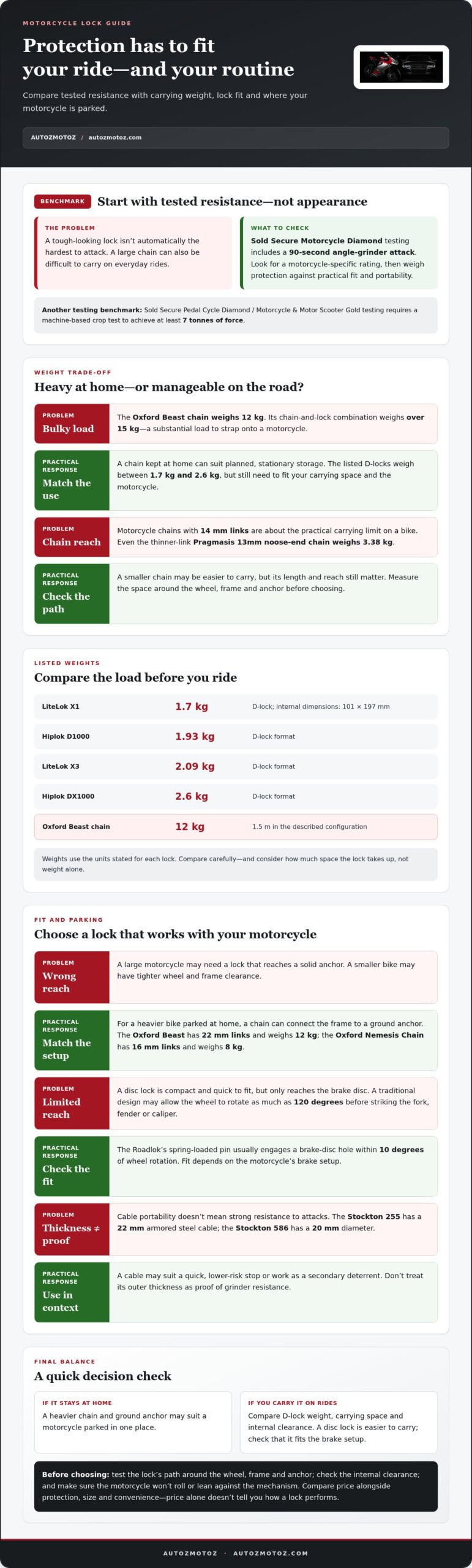
Security ratings help separate tested resistance from impressive-looking hardware. According to Sold Secure, Motorcycle Diamond testing includes a 90-second angle-grinder attack. Sold Secure Pedal Cycle Diamond / Motorcycle & Motor Scooter Gold testing requires a machine-based crop test to achieve at least 7 tonnes of force. Look for a motorcycle-specific rating, then weigh that protection against what you can realistically carry.
A compact D-lock can be easier to pack than a heavy chain, but dimensions matter as much as weight. The LiteLok X1 weighs 1.7 kg, with internal dimensions of 101 x 197 mm and external dimensions of 143 x 265 mm. Its shackle measures 21 x 24 mm, while its lock body measures 35 x 175 mm. Those figures help you judge whether it can pass through your wheel and around a fixed anchor.
Here’s how several options compare. Weights use the units stated for each lock, so compare them carefully.
| Option | Weight | Size or carrying detail | Practical takeaway |
|---|---|---|---|
| LiteLok X1 | 1.7 kg | Internal: 101 x 197 mm | Compact dimensions for a D-lock |
| LiteLok X3 | 2.09 kg | D-lock format | Compare added weight with your carrying space |
| Hiplok D1000 | 1.93 kg | D-lock format | A lighter listed option than the DX1000 |
| Hiplok DX1000 | 2.6 kg | D-lock format | More weight to account for on rides |
| Oxford Beast chain | 12 kg | 1.5 m in the described configuration | Better suited to planned storage than casual carrying |
Choose around your routine, not just the specification sheet. A lock kept at home can be heavier than one carried every ride. The Oxford Beast chain weighs 12 kg, while the chain-and-lock combination weighs over 15 kg. That’s a substantial load to strap onto a motorcycle. By contrast, the D-lock weights above sit between 1.7 kg and 2.6 kg.
Chain thickness also changes the carrying equation. Motorcycle chains with 14 mm links are about the practical carrying limit on a bike. The Pragmasis 13mm noose-end chain weighs 3.38kg, showing that even a thinner-link chain can become a serious load. A smaller chain may be easier to carry, but its length and reach to an anchor still matter.
Before choosing, measure the space around your wheel, frame, and anchor, then compare it with the lock’s internal clearance. Motorcycle lock reviews are most useful when they weigh fit and carrying weight alongside security, rather than treating either as a standalone advantage.
Choosing locks for bulky versus regular bikes
A large motorcycle needs a lock that can reach a solid anchor without awkward positioning. A regular bike may have tighter clearance around the wheel and frame, making a compact disc lock or D-lock easier to use. Match the lock’s reach and mechanism to your parking spot, not just its security rating.
For a heavier bike parked at home, a chain can connect the frame to a ground anchor. The Oxford Beast chain has 22 mm links and weighs 12 kg, so it makes more sense as a stationary setup than everyday luggage. The Oxford Nemesis Chain has 16 mm links and weighs 8 kg. A regular commuter may find either bulky; a garage-based rider can leave it secured at home.
Cable locks are portable, but portability isn’t the same as strong resistance to attacks. The Stockton 255 Armored Cable Lock has a 22 mm armored steel cable, while the Stockton 586 Cable Lock has a 20 mm diameter. Consider a cable for quick, lower-risk stops or as a secondary deterrent, rather than treating its outer thickness as proof of grinder resistance.
A disc lock is smaller and quick to fit, but its reach is limited to the brake disc. A traditional design may let the wheel rotate as much as 120 degrees before striking the fork, fender, or caliper. The Roadlok’s spring-loaded pin usually engages a brake-disc hole within 10 degrees of wheel rotation. That mechanism reduces the free movement, but fit depends on the motorcycle’s brake setup.
Alarm features add noise, not a physical barrier. The Stockton Alarm Disc Lock has a 110 dB alarm, and the ABUS GRANIT Detecto SmartX 8078 has a built-in 100-decibel alarm. A smartphone-connected version can add remote functions, but the lock still needs a secure physical fit. Treat sound as an alert layer; hardened construction and secure attachment address the lock itself.
Do motorcycle locks qualify for insurance discounts in the United States? A lock doesn’t automatically earn a discount; insurers set their own policy terms. Security devices may be considered alongside coverage, storage, and theft-prevention requirements, so the specific policy determines what applies.
Before choosing, test the lock’s path around the wheel, frame, and anchor, then check that the motorcycle won’t roll or lean against the mechanism. For a heavy bike parked in one place, a chain and ground anchor can be practical. For regular rides, a disc lock is easier to carry, while a cable is suited to lighter-duty use. Choose a lock that fits both your motorcycle and your parking routine.
Popular motorcycle lock products and prices
Price alone won’t tell you how a lock performs. Compare each option’s rating, construction, locking style, and carrying demands. A premium price doesn’t make a lock suitable for every motorcycle, while a lower-cost option may work well in a secondary role. Assess resistance to cutting separately from everyday fit.
The Litelok X3 is a useful reference point for comparing higher-security D-locks. Its listed US price is excluded here, but its features still give you a practical comparison: the X3 weighs 2.09 kg and uses a compact D-lock format. Compare it with the LiteLok X1, which weighs 1.7 kg, then decide whether the added weight and price fit your intended use. Don’t assume either model automatically offers better value for every rider.
Other D-locks occupy different places in the selection. Consider the carrying demands of the Hiplok D1000 and DX1000 when comparing them. ABUS’s Super Extreme 2500 weighs 2.09 kg. These examples show why the highest price shouldn’t be your only filter: fit, carrying practicality, and the lock’s tested rating all matter. Check the same criteria across each product rather than judging by brand name alone.
| Product | Market listing to compare | Useful comparison point |
|---|---|---|
| LiteLok X3 | US listing | Compare against the LiteLok X1 |
| Hiplok DX1000 | US and UK listings | Compare each market separately |
| ABUS Super Extreme 2500 | US and UK listings | Check rating and lock dimensions |
| Oxford Nemesis Chain | US listing | Consider chain security and carrying needs |
| Kryptonite Keeper Disc Lock | US listing | Compare its role with a chain or D-lock |
Chains change the value calculation. The Oxford Nemesis Chain has 16 mm links and weighs 8 kg; the Oxford Beast chain has 22 mm links and weighs 12 kg. The Kryptonite Keeper Chain uses 7 mm links. Those differences affect bulk and intended use, so compare the chain itself, its lock, and the place you’ll secure it. A large chain may be better suited to fixed parking than daily carrying.
Prices are listed in both US dollars and UK pounds across these products. Keep each market’s listings separate instead of treating currencies as a direct ranking. For your shortlist, note the local price, security rating, weight, and locking format in one place. Then compare the LiteLok X3 with options that serve the same purpose, not unrelated locks selected only because their sticker prices look lower.
Motorcycle lock types and product comparisons
No single lock type addresses every weak point. Compare physical resistance, fit, and ease of use before deciding how to secure your motorcycle.
Motorcycle Lock Types
A D-lock, chain, cable, and disc lock solve different problems. The LiteLok X1 is described as five times more angle-grinder resistant than other best-selling D-locks. That claim speaks to cutting resistance, not every threat: thieves may also target a lock’s cylinder or exploit poor positioning. Shackle strength and secure attachment both matter.
Chains connect a motorcycle to a separate ground anchor, which makes them useful for fixed parking. The Oxford Beast has 22 mm links, while the Oxford Nemesis has 16 mm links. Those figures help compare construction, but chain weight also affects carrying. A cable is lighter and more flexible, yet its format makes it better suited to secondary security than a hardened chain.
Disc locks are compact and attach at the brake disc. A traditional version may let the wheel rotate as much as 120 degrees before it hits the fork, fender, or caliper. Roadlok’s spring-loaded pin usually engages a disc hole within 10 degrees of wheel rotation. An alarm can add an audible warning, but it doesn’t replace a physical barrier.
Ratings provide a separate way to compare tested resistance. Sold Secure Motorcycle Diamond testing includes a 90-second angle-grinder attack. Sold Secure Pedal Cycle Gold / Motor Scooter Silver testing allows a 5-minute attack. Read the exact category: a cycle rating and a motorcycle rating are not interchangeable labels.
For a practical comparison, start by matching the lock to the parking point. A chain needs enough reach to secure the bike to an anchor; a disc lock needs compatible access to the brake disc. Then compare the shackle or link construction, security rating, and whether the weight is manageable for regular carrying. A lightweight cable can supplement a stronger primary lock, but shouldn’t be treated as equivalent protection.
Customer Reviews of Motorcycle Locks
Customer reviews are most useful for everyday details such as fit, handling, and alarm usability. They can help you judge convenience, but don’t establish how a lock performs against an angle grinder or a picking attempt.
Separate owner feedback from test results. For example, the LiteLok X1’s grinder-resistance description is a product claim, while Sold Secure Motorcycle Diamond testing includes a 90-second grinder attack. A review describing easy locking or awkward carrying can add context, but it can’t replace a tested rating.
Look for comments that describe a specific motorcycle and parking setup. A disc lock that fits one brake disc may not suit another; a chain that reaches a ground anchor in one garage may be cumbersome elsewhere. Feedback about a battery-powered alarm can help you assess its operation, while reports of a stolen bike don’t by themselves prove the lock failed.
Use reviews as a final filter, not the whole verdict. See whether several comments raise the same practical issue, then compare those details with the lock’s dimensions, construction, and rating. Separating convenience feedback from claims about resistance makes it easier to choose a lock that fits your motorcycle and routine.
What are the highest-rated motorcycle locks in 2026?
A rating is more useful than a product’s toughest-sounding marketing line. The Oxford Beast chain is rated Sold Secure Motorcycle Diamond, a category whose testing includes a 90-second angle-grinder attack. That makes it a standout for buyers prioritizing tested grinder resistance, but its 12 kg chain weight makes carrying it a different proposition.
Sold Secure categories describe specific tests, not a guarantee that a lock can’t be defeated. Motorcycle Diamond testing includes an angle-grinder attack; Pedal Cycle Gold / Motor Scooter Silver testing allows a 5-minute attack. The categories also differ in their attack methods and intended applications. Check the exact rating shown for a lock, rather than assuming a cycle rating means the same thing as a motorcycle rating.
The Oxford Beast is built around a 1.5 m chain in the described configuration, with 22 mm links and a 30 mm hardened locking pin. Those details matter alongside its Diamond rating: the chain needs a suitable anchor, and its length affects where you can secure the bike. Its 12 kg weight makes it more suited to a fixed parking setup than regular carrying.
For a portable D-lock comparison, the LiteLok X1 is described as five times more angle-grinder resistant than other best-selling D-locks. That product claim is distinct from a Sold Secure rating. The X1 weighs 1.7 kg and has internal dimensions of 101 x 197 mm, so compare its clearance with your motorcycle’s wheel and frame before deciding whether its format fits.
Other named locks provide useful construction comparisons, but don’t treat specifications as a substitute for a verified rating. The Oxford Nemesis Chain has 16 mm links, while the Oxford HD Chain Lock has 9.5 mm links and Sold Secure Silver approval for scooters. That scooter-specific approval shouldn’t be presented as Motorcycle Diamond. Choose the category that matches the vehicle and use case.
Use this quick comparison process:
- Read the exact certification category and intended vehicle class.
- Compare the test level, including grinder or cropper attack testing where applicable.
- Check the lock’s dimensions, weight, and attachment method against your parking setup.
- Separate tested ratings from product descriptions and owner impressions.
There isn’t one highest-rated lock for every parking situation. The Oxford Beast has the stated Motorcycle Diamond rating, while the LiteLok X1 emphasizes grinder resistance in a more portable D-lock format. Choose by rating, fit, and whether you can use the lock consistently. For a grounded next step, compare motorcycle security accessories by their tested category and real-world carrying demands.
AutozMotoz: Automotive Accessories and Product Reviews
AutozMotoz publishes reviews and comparisons of automotive accessories and products to help you weigh practical trade-offs before choosing. When comparing motorcycle locks, look beyond the headline rating: consider lock type, carrying weight, fit, and how you’ll secure your bike. A heavy chain may suit a fixed parking setup, while a compact disc lock may be easier to carry on regular rides. The right choice depends on which trade-offs work for your motorcycle and routine. Explore AutozMotoz for clear product comparisons that support your decision without assuming one lock suits everyone. Visit autozmotoz.com to read more reviews and comparisons.
Make Your Next Lock Choice Count
The best choice is the lock that fits your motorcycle, parking setup, and riding habits. Before buying, picture it in use: where it will sit, how you’ll carry it, and whether you’ll use it consistently. A security feature only helps if the lock works for your routine.
Use motorcycle lock reviews as a comparison tool, not a substitute for matching the lock to your bike. AutozMotoz publishes reviews and comparisons of automotive accessories and products, giving you a practical way to weigh options as you narrow your shortlist. Keep your priorities clear, and don’t let a bold product claim make the decision for you.
Explore AutozMotoz’s accessory reviews and comparisons as you consider your next motorcycle security choice. Take the time to choose a setup you’ll use, then ride with greater confidence in your everyday routine.
Frequently Asked Questions
Which is the most angle grinder-resistant bike lock in 2026?
The Oxford Beast chain has the clearest high-level certification in this comparison: it is rated Sold Secure Motorcycle Diamond. That testing includes a 90-second angle-grinder attack. The LiteLok X1 is described as five times more angle-grinder resistant than other best-selling D-locks, but that product claim is different from a certification. Compare the test category and the lock’s fit for your parking setup.
How do motorcycle chain, disc, U-lock, and folding locks compare?
Chains can secure a frame to a fixed anchor, but their bulk makes them less convenient to carry. Disc locks are compact and attach at the brake disc, while a U-lock or D-lock can pass around a wheel or frame if its opening is large enough. Folding locks pack neatly, though their reach and linked construction vary by model. With any type, check which parts of your motorcycle it can secure.
Which motorcycle locks are most resistant to angle grinders and bolt cutters?
Look for a motorcycle-specific rating that includes both cutting methods, rather than relying on shackle thickness alone. Sold Secure Motorcycle Diamond testing includes a 90-second angle-grinder attack, while Motorcycle Diamond / Motor Scooter Gold testing requires a machine-based crop test achieving at least 7 tonnes of force. The Oxford Beast carries the Motorcycle Diamond rating. Use its certification alongside practical checks for fit and anchoring.
How much do popular motorcycle locks cost in the United States?
US prices vary by lock type and construction, so compare products within the same category. A cable, alarmed disc lock, hardened D-lock, and heavy chain serve different purposes and shouldn’t be ranked by price alone. First decide what you need, then compare each option’s materials, security rating, carrying demands, and features. This makes it easier to judge the cost against how you’ll use the lock.
Which motorcycle locks are easiest to carry and use?
Small disc locks and grip-style locks are usually easier to carry than chains. Their compact formats suit quick stops, but they secure different parts of the bike than a chain or D-lock. Check the lock’s dimensions and placement before relying on it as your only device.
How do you secure a motorcycle with a lock to reduce theft risk?
Park where you can secure the motorcycle to a fixed anchor, and pass a chain through the frame rather than only through a removable part. Keep the lock off the ground, where tools are harder to brace, and avoid leaving excess chain slack. Add a disc lock as another layer, and use a reminder cable to avoid riding away with it fitted.
Are motorcycle disc locks with alarms effective, and how reliable are they?
An alarm adds an audible warning, but it doesn’t physically prevent a wheel from moving or stop a thief from attacking the lock. The ABUS GRANIT Detecto SmartX 8078 has a built-in 100-decibel alarm; the Stockton Alarm Disc Lock is rated at 110 dB. Treat sound as a useful extra, and make the lock’s physical fit and resistance your primary considerations.