
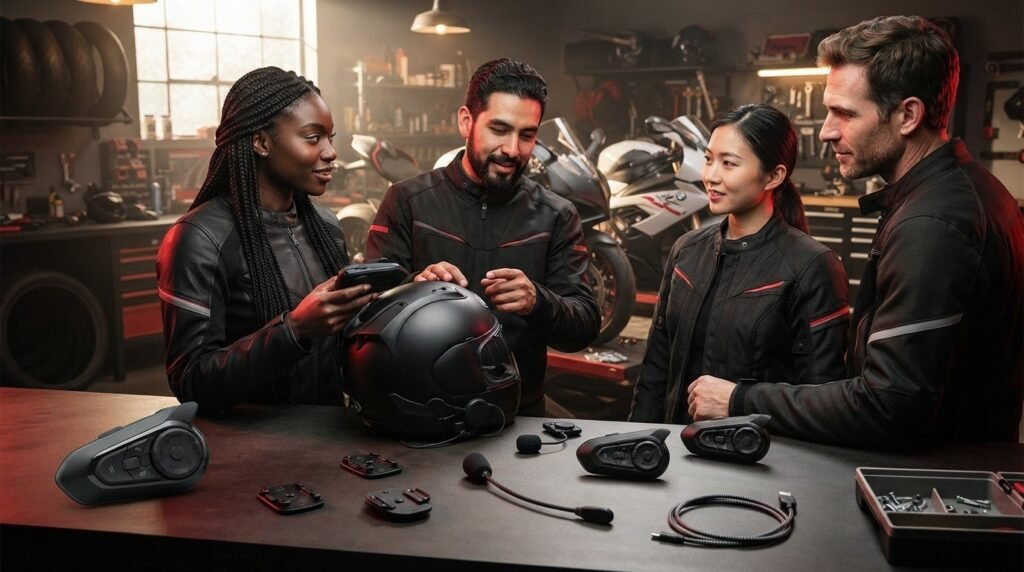
The longest-range intercom isn’t automatically the right one for your ride. A Bluetooth intercom lets you talk with other riders through equipment fitted to your helmet, and a useful motorcycle communication systems comparison starts with who needs to connect: the Cardo FREECOM 4X supports groups of up to four riders, while the Sena 50S is listed with a communication range of 2 km. The real choice is about fit and function, not just a headline spec.
It’s easy to focus on range or sound quality and assume the rest will fall into place. But universal units and helmet-specific systems can differ in mounting, control placement, and how well they suit your helmet and riding habits.
This guide compares the practical trade-offs in audio, controls, compatibility, battery life, and charging. You’ll learn what each type is designed to do, where compromises arise, and how to narrow your options to a system that suits your helmet and the way you ride.
Key Takeaways
- Choose between a universal unit and a helmet-specific system by weighing mounting flexibility against a closer fit with your helmet.
- Compare speaker setup and control options against how you actually ride, not just the feature list.
- Check how a system connects with your helmet and the devices you already use before settling on a model.
- Match battery life and charging needs to your typical rides so power management doesn’t become a mid-ride distraction.
- Use AutozMotoz reviews and comparisons to weigh motorcycle accessories and automotive products before deciding what suits your needs.
Universal and helmet-specific Bluetooth intercoms
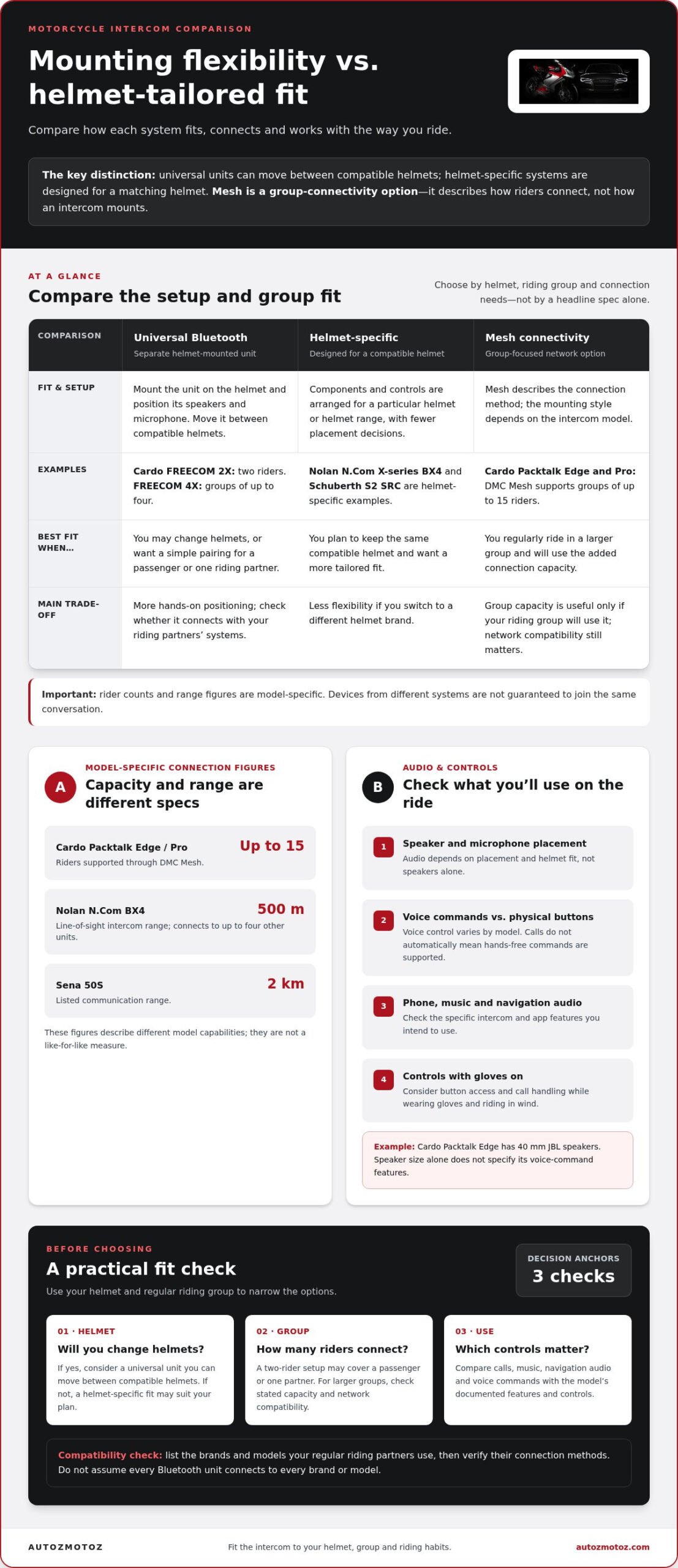
There’s no single best motorcycle intercom for every rider in 2026: Cardo Packtalk Edge and Pro suit group rides, supporting up to 15 riders through DMC Mesh, while FREECOM 2X supports two riders. Cardo and Sena differ by model and riding need: Cardo offers Bluetooth and DMC Mesh options, while the Sena 50S lists a communication range of 2 km.
Universal Bluetooth Intercoms
A universal Bluetooth intercom is a separate unit mounted on the helmet, with speakers and a microphone positioned inside. Its main advantage is flexibility: you can move it between compatible helmets rather than choosing a system made for one helmet line. For a rider who changes helmets, that can be practical. Cardo FREECOM 2X supports two riders, while FREECOM 4X supports groups of up to four.
That flexibility requires some hands-on setup. Position the speakers and microphone, then mount the unit where you can reach the controls with gloves on. A universal kit may suit commuting or occasional conversations with a passenger, while group riders may prefer a model with more connection options. Don’t assume every Bluetooth unit connects to every brand or model.
Helmet-Specific Bluetooth Intercoms
A helmet-specific intercom is designed to integrate with a particular helmet or helmet range, rather than moving freely between different shells. The Nolan N.Com X-series BX4 and Schuberth S2 SRC are examples of helmet-specific systems. Their appeal is a more tailored fit, with fewer placement decisions than a universal kit. The trade-off is flexibility: switching helmet brands may mean changing systems.
Choose this route when you intend to keep the same compatible helmet and want the system’s controls and components arranged for it. For example, the Nolan BX4 connects to up to four other units and has a line-of-sight intercom range of 500 metres. Those figures describe that model, not every helmet-specific system.
Entry-Level and Advanced Intercoms
Entry-level intercoms focus on core Bluetooth communication, making sense for solo rides with occasional calls to a passenger or one riding partner. Advanced systems add options for larger groups, as the Cardo Packtalk Edge and Pro show with DMC Mesh support for up to 15 riders. More capability is useful only if your riding group will use it.
Compare the number of riders you need to connect, the system’s network type, and how often you ride in a group. The Cardo FREECOM 2X’s two-rider limit suits a simpler pairing; a group that regularly spreads out may value mesh. A longer feature list alone doesn’t make an intercom the better match.
Mesh and Bluetooth Connectivity
Bluetooth intercom connectivity links riders through paired devices, making it a straightforward fit for a small, predictable group. Mesh networking, such as Cardo DMC Mesh, is aimed at group communication and supports up to 15 riders on the Packtalk Edge and Pro. These are model-specific capabilities, not a guarantee that devices from different systems will join the same conversation.
Before choosing, list the brands and models your regular riding partners use, then compare their connection methods. If you usually ride with one passenger, a two-rider Bluetooth setup may be enough. For a larger group, check the stated group capacity and whether everyone’s systems use a compatible network.
| Option | Fit and setup | Connectivity example | Best suited to |
|---|---|---|---|
| Universal Bluetooth | Separate unit mounted on a helmet | Cardo FREECOM 2X, two riders | Riders who may change helmets |
| Helmet-specific | Designed for a compatible helmet | Nolan N.Com BX4, up to four other units | Riders keeping a matching helmet |
| Mesh system | Group-focused connectivity | Packtalk Edge and Pro, up to 15 riders | Regular larger-group rides |
Match your helmet and usual group size to the mounting style and connectivity you’ll actually use.
Audio, voice control, and firmware updates
Clear audio depends on more than the speakers: placement, helmet fit, and controls all affect everyday use. Compare the features you’ll rely on, from music and phone calls to voice commands and updates.
Voice Commands and Smartphone Features
A Bluetooth intercom can connect to a smartphone so you can listen to audio or use supported phone features through your helmet setup. Voice commands offer another way to control compatible functions, while physical buttons provide a direct alternative. Features vary by model, so compare the tasks you need rather than assuming every unit works the same way.
For touring, consider how you’ll use phones, navigation audio, and music in one ride. Check the manufacturer’s feature descriptions for the specific intercom and its app, then note whether voice control covers the functions you care about. A Cardo Packtalk Edge, for example, has 40 mm JBL speakers; that tells you the speaker size, not which voice commands the system supports.
Phone Calls and Voice Activation
Handling phone calls and using voice activation solve different problems. Calls let you speak through the microphone and hear the other person through the speakers. Voice activation can start or manage certain functions without pressing a button. Call support doesn’t automatically mean a system offers hands-free voice commands, so compare these features separately.
Before buying, identify the phone features you expect to use and check the intercom’s documented controls. Find out whether calls are answered with a button, a voice prompt, or another supported method. This matters with a motorcycle helmet, where gloves and wind noise can make small controls harder to manage than they seem indoors.
Hands-Free Voice Control
Hands-free voice control can reduce the need to press buttons for supported tasks. Its usefulness depends on the system’s command set and how reliably the microphone picks up your voice inside your helmet. Compare that with physical controls: buttons are straightforward, while voice commands offer another way to operate the Bluetooth intercom.
Try a simple check before a touring day: review the manual, pair your phone, and test supported commands while stationary. Also compare speaker fit. Cardo describes the Packtalk Edge, Packtalk Pro, and Packtalk Neo as submersible to one metre for 30 minutes; the Edge has 40 mm JBL speakers. Those are distinct specifications, so weigh each against your needs.
Firmware updates can change or improve device software, but update steps and available functions depend on the model. Check the manufacturer’s update instructions and version notes before installing, and do it before a ride rather than leaving setup until you’re ready to leave. For more gear context, explore motorcycle accessory reviews and comparisons.
Compatibility with helmets and other devices
Universal units can work with more helmet brands, while helmet-specific systems are designed for compatible models. Which motorcycle communication systems suit different helmet types and brands? The answer depends on speaker space, mounting surfaces, and the devices you plan to pair. A useful motorcycle communication systems comparison starts with these practical fit questions, not the feature list alone.
Helmet Compatibility and Installation
A universal kit typically uses a clamp or adhesive mount, with speakers and a microphone positioned inside the helmet. Identify your helmet model and check where the padding leaves room for speakers before buying. Then compare the mounting method with the shell shape and removable liner. A control unit mounted in the wrong place can be awkward to reach with gloves.
Helmet-specific systems take a different route: their components are designed for certain helmet models or ranges. Nolan N.Com and Schuberth S2 SRC are examples of systems tied to matching helmets. That integration can make placement more straightforward, but it narrows your options if you later switch helmet brands. Treat the helmet and intercom as a fit pair, especially if you expect to replace either one.
Helmet Speakers and Earbuds
Helmet speakers sit inside the lining, close to your ears, and connect to the intercom unit. Their position matters: a speaker that presses against your ear can be uncomfortable, while one sitting too far away may make audio harder to hear. The Cardo Packtalk Edge has 40 mm JBL speakers, a concrete specification to compare with your helmet’s speaker recesses.
Earbuds offer a different fit, but compatibility depends on their shape, cable routing, and how they sit under your helmet. Don’t assume they’ll stay comfortable once the helmet is on. Test the complete setup while stationary: check that the helmet sits normally and that the speaker or earbud stays in place when you move your head.
Helmet shape affects practical fit. Full-face, open-face, and modular helmets can have different lining layouts and space around the ears. Before choosing a universal intercom, inspect the cheek pads, liner, and outer shell for clear speaker and mounting positions. For a helmet-specific system, match your exact helmet model to the system’s stated compatibility.
Phone or separate GPS compatibility is a different consideration from helmet fit. Review the intercom’s connection options for your devices, then pair one device at a time and test the audio routing. In a motorcycle communication systems comparison, check whether your phone and GPS can connect as intended. A familiar brand name alone doesn’t establish compatibility.
- Check the helmet: identify its model and inspect the lining, speaker recesses, and mounting area.
- Check the intercom: compare its installation method and stated helmet compatibility.
- Check the fit: position speakers, wear the helmet, and test comfort before a ride.
This quick fitting routine helps you compare universal and helmet-specific setups on practical points: mounting, speaker placement, comfort, and connections to your phone or GPS.
What is a Bluetooth intercom?
A Bluetooth intercom links a helmet microphone and speakers with another rider’s system or a paired phone. U.S. rules vary by state, so an intercom’s features alone can’t establish whether its use is legal everywhere. Check the rules that apply to motorcycle riders where you ride.
Rider-to-Pillion Communication
Rider-to-pillion communication connects the person riding the motorcycle with the passenger seated behind them. The Midland BTX1 rider-and-pillion intercom has a range of up to ten metres, a setup aimed at keeping conversation between two people rather than linking a larger group. Its microphone picks up speech, while helmet speakers deliver the passenger’s voice.
For this use, compare how the system handles a direct conversation between two people, not just its maximum group capacity. A passenger system can make it easier to share directions or discuss a stop without shouting over the engine. Test microphone placement with both helmets on: a mic that shifts away from the rider’s mouth can make speech harder to hear.
Communication Range
Range describes the distance a system can maintain between connected riders, but the listed figure isn’t the whole story. The Sena 50R lists 3,500 feet in line of sight and 1,500 feet with a moderate amount of obstacles. That contrast shows why buildings, terrain, and the group’s spacing matter during real riding.
Let your route guide your choice. A pair riding close together has different needs from riders spread across winding roads or separated by traffic. Compare the stated range and the conditions behind it, then consider how easily your group can reconnect if the signal drops. Range is a useful selection factor, not a guarantee of uninterrupted contact.
Rider Capacity
Rider capacity is the number of people a system can connect in an intercom group. A two-person setup fits a rider and passenger, while Cardo Packtalk Edge and Pro DMC Mesh support group rides of up to 15 riders. That larger capacity suits coordinated group conversations, but it won’t matter much if you usually ride with one companion.
Count the people who need to talk, then match that need to the system’s stated capacity and connection type. Also distinguish a passenger link from a multi-rider group: the Midland BTX1’s up-to-ten-metre range describes rider-and-pillion communication, not a large-group network. Those details help separate the technology that solves your actual riding problem.
Intercoms can help riders share directions or coordinate a stop, but conversation can also compete for attention. Keep exchanges brief when traffic or road conditions demand focus, and learn the controls before setting off. For a practical installation check, fit the microphone, connect the intended devices, and test speech and volume while stationary.
Battery life and charging
A long battery rating looks useful, but compare how each brand describes it. Cardo Packtalk Edge offers up to 13 hours of talk time, while the Cardo Spirit HD is listed with a 13-hour battery life. Those figures describe different models and rating language, so treat them as a guide to compare, not identical test results.
Published figures vary across models. The Packtalk Edge and Pro are listed with 13-15 hours of battery life, while Cardo Spirit and Freecom 2X/4X models are listed with 10-13 hours. Other examples include 13 hours for the Sena 50S, 10 hours for the Freecom 4X, and 16 hours for the Midland BTX1 Pro.
These differences can help narrow your shortlist, but your riding habits matter too. A ride spent mostly listening to music or using a smartphone may place different demands on a system than one focused on intercom conversation. Check whether the stated figure refers to talk time or general battery life, and compare like with like rather than chasing the largest number.
Charging is part of the ownership routine, not an afterthought. Before a touring day, charge the unit and check that its charging port remains accessible when it’s mounted on the helmet. If you travel, keep the charging lead with your riding kit and recharge after rides that leave the battery low. Follow the model’s instructions for charging and storage.
Wireless connectivity keeps the helmet setup untethered while riding, but the unit still needs charging between rides. If your phone also needs power, plan for both devices rather than assuming the intercom can charge it. Battery figures alone don’t show whether a system supports charging while in use, so check the manufacturer’s instructions for that specific model.
Water protection deserves the same careful reading as battery life. Cardo describes the Packtalk Edge, Packtalk Pro, and Packtalk Neo as submersible to one metre for 30 minutes. That claim applies to those named units and describes a specific condition; don’t extend it to other brands or treat it as permission for activities the manufacturer doesn’t describe.
Before choosing an expensive or entry-level unit, make a simple comparison: note the model’s stated battery figure, whether it specifies talk time, and how its charging routine fits your rides. Check water-protection claims separately. Battery life, charging, and water resistance are distinct criteria, even when a product page presents them together.
For example, the Midland BTX1 Pro’s listed 16 hours exceeds the Sena 50S’s 13 hours, while the Packtalk Edge’s up-to-13-hour talk time uses a different description. Compare the intended use and rating terms, then choose the system that fits your ride length and charging habits.
AutozMotoz: Reseñas y comparativas de accesorios y productos automotrices
AutozMotoz publishes reviews and comparisons of automotive accessories and products, helping you weigh practical trade-offs when choosing motorcycle gear. After comparing intercom fit, connectivity, audio, and battery life, use those criteria to decide which features matter for your riding routine and helmet.
A passenger setup, for example, calls for different priorities than a larger riding group. Reviews and comparisons let you examine product information side by side, distinguish useful features from impressive-sounding extras, and narrow your options based on compatibility and everyday use. The goal is an informed choice, not a one-size-fits-all recommendation.
Explore AutozMotoz’s accessory and product reviews and comparisons.
Make your next ride a better-informed choice
The right intercom is the one that fits your helmet, riding group, and routine, not the one with the longest feature list. Use this motorcycle communication systems comparison to turn your priorities into a shortlist, then decide which trade-offs you’re comfortable with every day. A system that looks impressive on paper still needs to work with the gear and devices you use.
As you weigh your final options, AutozMotoz’s reviews and comparisons of accessories and automotive products can help you make an informed choice. Use them to compare practical details, identify features that matter for your riding, and avoid choosing based on marketing claims alone.
Explore AutozMotoz’s product reviews and comparisons as you narrow your options. Choose with your own ride in mind, and you’ll be better prepared to enjoy the miles ahead.
Frequently Asked Questions
Wired or Wireless?
Wireless Bluetooth systems avoid a cable between your helmet and phone, while wired setups connect components with physical cables. Wireless can make getting on and off the bike simpler; wired connections don’t rely on a wireless link between those components. Consider where you’ll mount your phone, how you store your helmet, and whether cables could snag or get in the way. These practical details often determine which setup fits better.
What are the best motorcycle intercom systems for rider-to-passenger communication?
For a rider and passenger, look for an intercom designed for direct two-person communication, such as the Midland BTX1 rider-and-pillion system. Before choosing, consider whether both people will wear compatible units and whether each helmet can accommodate a microphone and speakers comfortably. If you already own intercoms, matching connection methods matters. A simple pairing test while stationary can reveal control or fit issues before the first trip together.
Which motorcycle communication systems support mesh intercom, and how many riders can connect?
Mesh intercom systems can be useful for group rides, but capacity varies by model. For comparison, the Cardo FREECOM 4X uses Bluetooth intercom connectivity and supports groups of up to four riders. Choose mesh if your regular group needs its larger capacity; for a smaller crew, Bluetooth may cover the job. Before a group ride, agree on the system and connection method everyone will use.
What is the Bluetooth range and battery life of popular motorcycle communication systems?
Published model figures give you useful comparison points: the Sena 50S lists a communication range of 2 km and battery life of 13 hours. The Cardo FREECOM 4X lists a Bluetooth intercom range of up to 1.2 km and battery life of 10 hours. Range and battery ratings describe separate things. Compare the stated conditions and battery wording, then consider your route, group spacing, and charging routine.
How much do motorcycle communication systems cost in the United States?
Costs vary by model and features, so compare systems based on the capabilities you’ll use rather than price alone. Group connectivity, speaker specifications, and phone features can distinguish models, but a longer feature list doesn’t automatically mean better value. Shortlist systems based on helmet fit and riding needs, then compare their current listed prices before deciding.
How do motorcycle intercom systems compare for sound quality, noise cancellation, and voice control?
Compare speaker specifications alongside fit, since a speaker positioned poorly in your helmet can make listening harder. The Cardo Packtalk Edge has 40 mm JBL speakers, while the Packtalk Pro has 45 mm JBL speakers; size alone doesn’t settle sound quality. Noise handling and voice control are model-specific features. Look for descriptions of each function, then test the microphone and controls while stationary before riding.
What are common problems and safety risks with motorcycle communication systems?
Common hassles include a loose speaker, microphone placement that makes speech hard to hear, pairing problems, and a battery that needs charging. Check the fit and device connections before setting off, and learn the controls while stationary. Conversations or adjustments can distract you, so keep operation simple on the road and save setup changes for a stop. Clear audio and a secure fit start with careful installation.
Which motorcycle communication systems are best overall in 2026?
There’s no single best system for every rider in 2026. The right system depends on your helmet, group size, and riding needs.