
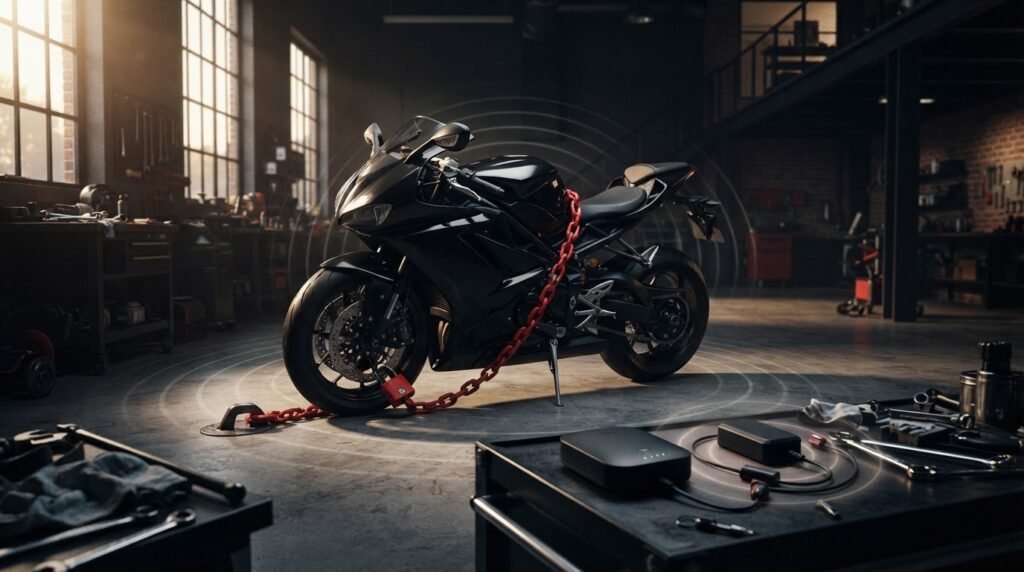
A motorcycle radar perimeter alarm detects movement around a parked bike; a motion- or shock-sensing alarm reacts when the motorcycle itself is disturbed. These are different tools, and neither replaces a physical lock. The right motorcycle anti theft products depend on where you park, how long the bike is unattended, and whether you can secure it to something solid.
It’s easy to assume a louder alarm or a GPS tracker is the obvious solution. But an alert can’t physically stop someone moving the bike, and a lock only helps if you use it. Your parking routine and theft exposure matter as much as product features.
This guide explains how perimeter alarms differ from bike-mounted alarms, what GPS tracking can and can’t do, and how disc locks, chains, and other locks compare. You’ll also find a practical way to assess your risk and choose a sensible combination, without treating any single device as a guarantee.
Key Takeaways
- Match the alarm to what you need it to detect: movement around the bike or disturbance to the bike itself.
- Factor a tracking service subscription into your GPS tracker decision, and consider how you’d act on location information after a theft.
- For a chain lock, prioritize hardened steel and secure it through the motorcycle’s frame to a fixed anchor where possible.
- Use a disc lock as a practical barrier to rolling, but think about how it fits alongside stronger physical security for your parking setup.
- Assess your routine, parking location, and exposure before choosing a combination of products; more devices don’t automatically mean better protection.
Motion- and shock-sensing alarms
Motion- and shock-sensing alarms alert you when a parked motorcycle moves or takes an impact. Each option has practical drawbacks: locks can be forgotten, alarms can trigger falsely or go unheard, and GPS tracking requires a tracking-service subscription.
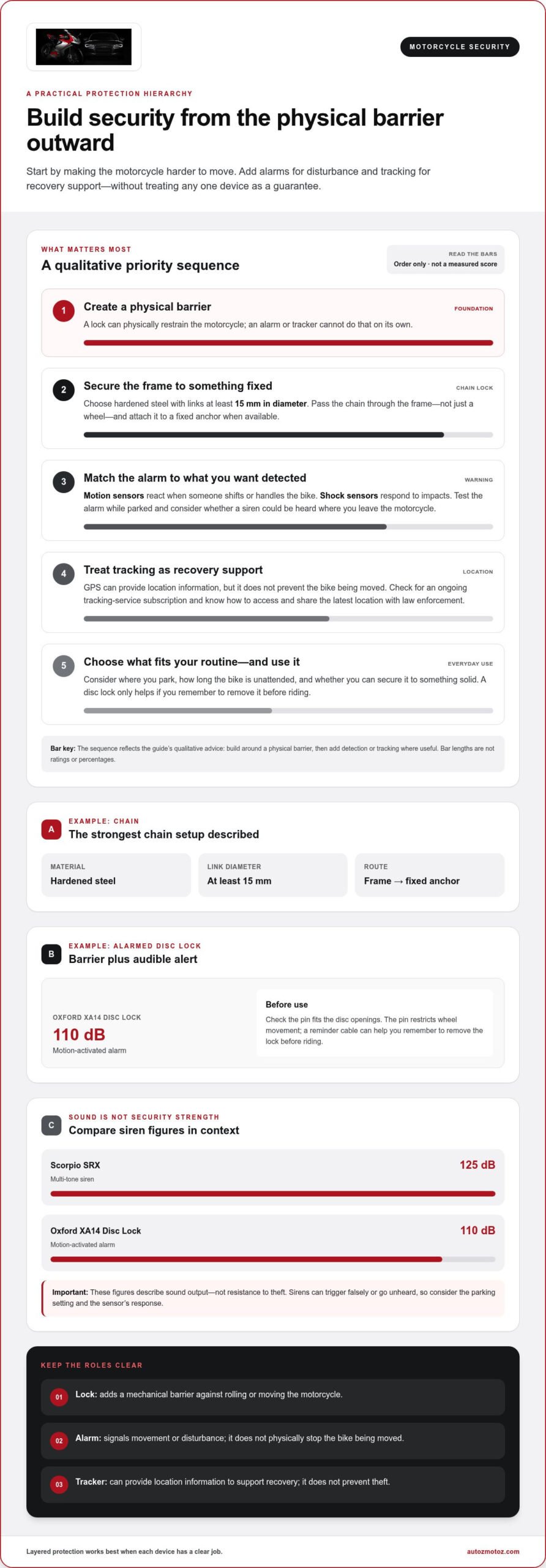
A motion sensor reacts when someone shifts or handles the bike; a shock sensor responds to impacts. Siren volume alone doesn’t tell you how well an alarm detects interference. The Scorpio SRX has a 125 dB multi-tone siren, while the Oxford XA14 Disc Lock has a 110 dB motion-activated alarm. Those figures describe sound output, not resistance to theft. Consider where you park, whether a siren could be heard, and whether the sensor’s response suits that setting.
Alarmed Disc Locks
An alarmed disc lock combines a physical barrier with a warning sound. The Oxford XA14, for example, has a 14 mm T-locking pin and a 110 dB motion-activated alarm. Its pin attaches through the brake disc, making the lock visible while restricting wheel movement. Before choosing one, check that its pin fits your motorcycle’s disc openings and that you’ll remember to remove it before riding. A reminder cable can make that step harder to miss.
Alarm Installation and Covers
Installing a motorcycle alarm may involve positioning a sensor and connecting a wired unit to the bike’s electrical system. Follow the product’s installation instructions, then test the alarm while the motorcycle is parked. If you use a cover, fit it after arming the alarm and check that normal cover movement doesn’t trigger the sensor. A cover can conceal the motorcycle, but it doesn’t replace a lock or alarm.
GPS Alarm Drawbacks
A GPS motorcycle alarm system combines an alert function with location tracking, but those serve different purposes: the alarm signals a disturbance, while the tracker helps locate the motorcycle. If you use a GPS tracker, check whether its service involves ongoing costs and factor them into your decision. A tracker also doesn’t physically prevent thieves from moving the bike. A disc lock or chain adds a mechanical barrier.
For a practical setup, match each device to a specific risk. Use a motion alarm to warn you about disturbance, and add a lock that physically restrains the wheel or frame. If you rely on a GPS tracker, understand how its service works and keep the subscription active. Test the alarm after installation, and get into the habit of removing the disc lock before every ride. This helps prevent the common mistake of treating a siren as a complete security plan.
GPS location tracking and recovery
GPS trackers can provide location information, while Bluetooth tags rely on nearby compatible devices. Neither physically prevents theft. If your motorcycle is stolen, contact local law enforcement, report the theft, and share the tracker’s latest location and device details with them.
GPS Tracker Types
GPS anti-theft trackers use location data to help you follow a motorcycle’s movements. A motorcycle-specific unit may connect to the bike’s electrical system or use its own power source. Check how the device gets power, sends location information, and fits your parking routine. GPS tracking devices require a tracking-service subscription, so consider that ongoing requirement before choosing one.
Placement affects a tracker’s usefulness. A unit that’s easy to spot may be removed, while a hidden tracker can be harder to reach for routine maintenance. Follow its installation instructions and make sure you can access it when needed. Then test the app or tracking interface while the motorcycle is parked, so you know where to find location details.
Tracking Effectiveness
GPS trackers can show reported locations, but they don’t stop thieves from moving a motorcycle. Their usefulness depends on the device having power and being able to send location data. Bluetooth tracking devices work differently: nearby compatible devices help report a tag’s location. Bluetooth can help with some searches, but it isn’t the same as a dedicated motorcycle GPS tracker.
Plan what to do after an alert. Can you open the tracking app, identify the motorcycle’s last reported position, and share those details? Practise these steps beforehand, not during a theft. A tracker can support recovery efforts, but it doesn’t replace a physical lock or an alarm that alerts people nearby.
If the motorcycle disappears, report the theft to local law enforcement, provide identifying details, then share the tracker’s latest location and any movement history. Don’t approach a suspected theft location yourself. Keep your device account accessible and know how to find its location screen. A tracker you can’t access quickly adds little value during a stressful search.
Before choosing a device, compare its power setup, tracking method, and ongoing service requirement. Consider where you park and whether you want location updates, a nearby-device search aid, or both. GPS and Bluetooth address different tracking needs, so choose the technology that fits your routine rather than assuming one device covers every situation.
What is the best way to secure a motorcycle?
Build motorcycle security around a physical barrier, then add detection or tracking where useful. A hardened-steel chain should pass through the motorcycle’s frame, not just a wheel.
A security rating describes tested resistance, not an insurance decision. Whether a device qualifies for approval or a discount depends on the insurer’s policy criteria.
Securing the Frame with a Chain
Choose a hardened-steel motorcycle chain with links at least 15 mm in diameter. Thread it through the frame, then secure it to a fixed anchor when one is available. A chain passed only through a wheel can leave the motorcycle easier to separate from its lock. Keep the chain snug and off the ground, where possible, to limit room for leverage.
Ratings, Certifications, and Testing
A rating gives you a way to compare products tested against a defined security standard. For example, the Oxford XA14 Disc Lock is certified Sold Secure ‘Motorcycle Powered Cycle Gold’. Treat that certification as a comparison point, not a promise against theft. Product testing assesses resistance to particular attack methods; the rating reflects the result under that scheme. Check the exact product and category named on its certification.
Available Security Systems
Security systems address different parts of a theft attempt. A chain and anchor physically restrain the motorcycle; a disc lock restricts wheel movement. A motion alarm draws attention to disturbance, while a GPS tracker can help locate a stolen bike. An immobilizer adds another layer by preventing the engine from starting. Choose based on your parking setup, then combine systems that address different weaknesses.
Alarm and Immobilizer Features
For an alarm, compare its trigger type, siren, and response to normal movement. A shock sensor reacts to impacts, while a motion sensor detects when the motorcycle is shifted. For an immobilizer, consider how it prevents starting and how you arm or disarm it. Check that the steps fit your routine, then test the system while parked before relying on it.
Keep the setup practical. If you park beside a fixed anchor, use a chain through the frame. If you rely on an alarm, test its trigger and response. A visible disc lock adds a clear physical deterrent, while a tracker supports location-based recovery. No single rating or device replaces a layered approach suited to where and how you park.
Product specifications and prices can help narrow the options, but check that a chain suits your motorcycle and parking setup. The Oxford Nemesis Lock and Chain has a 16mm hardened steel shackle and weighs 7.7kg, so consider its weight when deciding how you will carry or store it. The Gear Gremlin Nimrod Chain Lock has a 9.5mm hardened steel chain, which is below the 15 mm link size recommended above.
Compare the price and specifications with your security needs. Check whether the chain can pass through the frame and attach securely to a fixed anchor.
Handlebar, throttle, U-lock, and disc locks
Choose a lock for the movement you want to prevent and the routine you’ll actually follow. Handlebar, throttle, U-lock, and disc-lock designs each involve different fit and carrying trade-offs.
Handlebar and Throttle Locks
A handlebar lock connects the grip or brake lever to restrict steering or control movement. A throttle lock blocks throttle operation, but doesn’t anchor the motorcycle to a fixed object. Check the grip shape, clearance, and fit. Keyless ignition locks address starting rather than physical movement, so use them as one layer, not the whole setup.
U-Locks and Disc Locks
A U-lock can secure a motorcycle to a fixed object if its shackle reaches the frame and anchor. Check the opening size before buying, since a tight fit can limit where you attach it. The Kryptonite New York M18 WL U-Lock is one example of this format.
A disc lock clamps onto the brake disc and prevents the motorcycle from rolling more than a few inches. The Oxford XA14 has a 14 mm T-locking pin; check that the pin fits the openings in your brake disc. Alarmed models add a sound alert, while an unalarmed lock avoids relying on a battery. Add a reminder cable from the lock to the handlebar to prompt removal before riding.
For helmets, a dedicated helmet lock or a cable threaded through the helmet’s chin bar can deter casual removal. A cable lock is convenient for lighter gear, but its flexibility makes it less suitable as the motorcycle’s main physical barrier. Use it for a helmet or accessory, not as a substitute for a frame lock.
Angle-Grinder-Resistant Locks
Some locks are designed to resist angle-grinder attacks, but the label shouldn’t replace checking the specific design and intended use. Hiplok’s MD1000 is an anti-angle-grinder motorcycle disc lock, while the D1000 is an anti-angle-grinder D-lock. Compare the format with your parking spot: a disc lock restrains the wheel, while a D-lock can secure the motorcycle to an anchor when it fits.
Before settling on a lock, practise carrying and using it. A heavy U-lock may be awkward on daily rides, while a compact disc lock is easy to stow but doesn’t anchor the bike. Match the lock to your motorcycle, disc openings, and parking arrangement. For a keyless ignition system, learn its normal arming and disarming steps so the security feature doesn’t become a start-up problem.
What types of motorcycle anti-theft products are available?
Useful security devices do different jobs: slowing movement, drawing attention, or helping locate a stolen bike. A layered setup might combine a chain, an alarm, and a tracker, rather than expecting one device to do everything.
Chains and anchors: The Oxford Beast chain has 22 mm links and comes in 1.5 m and 2.0 m lengths. Choose a length that reaches the motorcycle’s frame and a fixed anchor without leaving excessive slack. A ground anchor gives the chain a secure attachment point; the Oxford Beast Ground Anchor weighs 4 kg. For a portable alternative, the Squire Massiv Chain & Lock is 1.2 m long and weighs 5.52 kg, a real carrying consideration on daily rides.
Alarms and disc locks: An alarmed lock pairs a physical obstacle with a sound alert. The Stockton 736 Alarmed Security Chain And Lock combines an alarm with a chain, while a motion-sensing alarm reacts when the parked motorcycle is disturbed. A disc lock restricts wheel movement, but doesn’t attach the motorcycle to a fixed object. Compare how each product fits your parking spot and how easily you can carry it.
Trackers and electronic security: GPS trackers provide location information through a tracking service, while an immobilizer prevents the motorcycle from starting. These devices have different purposes: one helps locate the bike, and the other interferes with riding it away. Add either to a physical lock based on your routine. Keep electronic devices powered and learn how to operate them before relying on them.
Covers and smaller locks: A motorcycle cover can conceal the bike and protect it from exposure, but it isn’t a physical theft barrier. Use it with a lock, not as security on its own. Cable locks can secure a helmet or accessory, while handlebar and throttle locks restrict particular controls. Match each device to what it can actually secure.
Start with your parking setup: note whether you have a fixed anchor, where the chain can pass, and how much gear you’ll carry. Then choose a primary physical lock and add detection or tracking for a separate need. Explore motorcycle accessory reviews and comparisons to compare product categories and narrow down a practical setup.
AutozMotoz: Reseñas y comparativas de accesorios y productos automotrices
AutozMotoz helps riders compare automotive accessories and products through reviews and comparisons. If you’re choosing between a chain, alarm, or tracker, use these comparisons to weigh each option’s purpose and practical trade-offs against your parking routine. A loud siren won’t secure a bike to an anchor, and a GPS tracker won’t physically stop someone moving it. Start with the risk you need to address, then compare products designed for that purpose. This is a useful next step once you’ve narrowed down your security approach and need to distinguish between product types and features. For straightforward automotive accessory comparisons, visit autozmotoz.com.
Make your next security choice count
Improve motorcycle security before your parking routine changes or a new concern arises. Review where you leave the bike, how often it stays unattended, and which part of your setup feels weakest. Then choose one practical improvement you’ll use consistently. Choosing motorcycle anti theft products works best when you know what problem each item should solve, rather than adding devices just because they sound advanced.
Keep your setup manageable, too. A lock that’s too awkward to carry or an alarm you rarely arm won’t serve your routine well. Revisit your choices when your commute, storage, or parking conditions change. For a grounded comparison before deciding what to add, explore AutozMotoz’s automotive accessory reviews and comparisons. A thoughtful choice won’t eliminate every risk, but it can make your everyday security habits more deliberate and consistent. Start with the change that fits your real life, then build from there.
Frequently Asked Questions
What is a motorcycle radar perimeter alarm?
A motorcycle radar perimeter alarm detects movement near a parked bike and warns you before someone touches it. Its protected zone surrounds the motorcycle, unlike a shock sensor, which reacts to an impact on the bike. Depending on the system’s settings, someone approaching or walking close by may trigger a perimeter warning. Position and adjust the sensor to reduce alerts from ordinary foot traffic in busy parking areas.
What are the best motorcycle locks and chains for theft prevention?
The best choice is one you can carry and use correctly at your regular parking spot. For a motorcycle kept in a garage, a chain that reaches a fixed anchor can form the main barrier. For quick stops, a compact disc lock is easier to carry, while a U-lock suits locations with a reachable anchor. Compare the lock’s fit, handling, and tested security rating rather than choosing by appearance alone.
How do I properly secure a motorcycle with a chain or disc lock?
Park close to a fixed anchor, then route the chain through a strong section of the frame and the anchor. Keep it clear of painted surfaces and moving parts, and close the lock fully. With a disc lock, fit the pin through a suitable brake-disc opening and place a reminder cable where you’ll see it from the handlebars. Before leaving, give the motorcycle a gentle push to confirm the lock is engaged.
How much do motorcycle disc locks, chains, alarms, and trackers cost?
Prices vary by product; no tracker price is provided.