
Looks alone won’t tell you which intercom is the better fit. In the Cardo Packtalk Edge vs Sena 50S comparison, there’s no objective winner on appearance; the Cardo’s clear practical distinction is its IP67 water-and-dust protection. Your riding group, helmet setup, and exposure to wet or dusty conditions matter more than a quick glance.
It’s fair to want a headset that looks right on your helmet, but its shape also affects how it mounts and feels in use. If your riding group mixes brands, compatibility may matter more than either unit’s styling.
This comparison covers appearance, group compatibility, helmet mounting, and protection from water and dust. Weigh the trade-offs against the rides you actually take, so you can choose an intercom that suits your setup rather than buying on looks alone.
Key Takeaways
- Compare battery-life claims with reported testing, and weigh how your audio use affects what matters on a ride.
- Match the intercom’s group features to your usual riding crew, especially if riders use different brands.
- Look beyond the unit’s profile: mounting brackets and speaker placement can shape how neatly it fits your helmet.
- Understand what the Cardo’s IP67 rating means for water and dust exposure before choosing gear for wet or dusty rides.
Do Sena or Cardo intercoms look better?
Looks are personal, but the Sena 50S and Cardo Packtalk Edge should be judged on more than profile. Battery claims, charging habits, and real-world range affect whether either unit suits your ride. Compare each headset on the helmet you use, then weigh the practical trade-offs alongside its appearance.
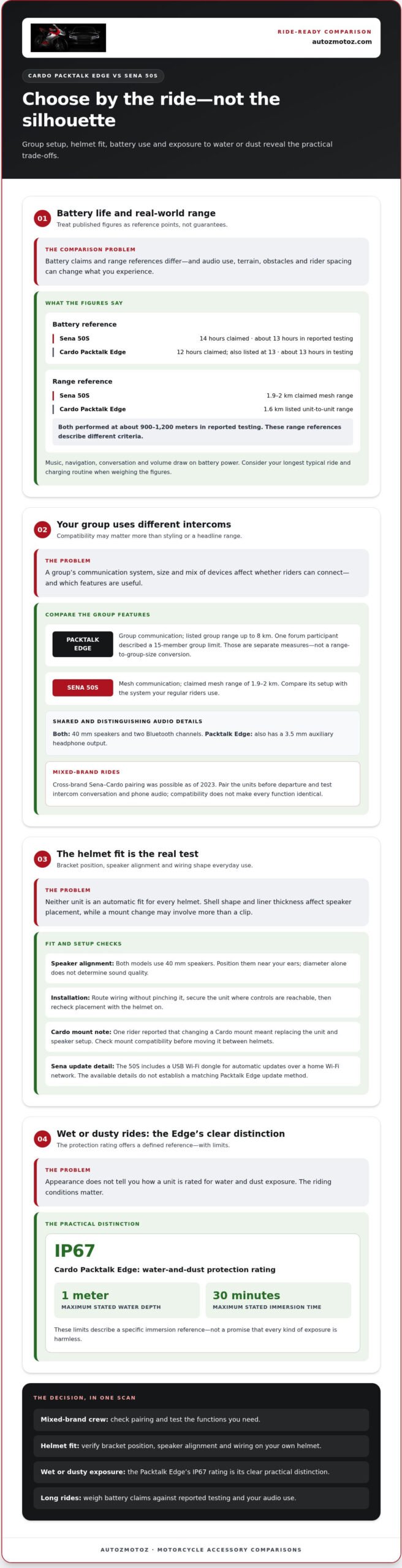
Battery figures vary by claim and test. The Sena 50S is claimed to last 14 hours, while the Cardo Packtalk Edge is claimed to last 12 hours. Battery-life listings and test results can vary, so treat them as estimates rather than guarantees. Treat those numbers as different reference points, not a guarantee for every ride.
How you use audio affects the comparison. Music, navigation, intercom conversations, and volume all draw on battery power. A long day with continuous audio makes charging access more important than it is for a short commute with occasional intercom use. Consider your typical ride before treating a small difference between battery claims as decisive.
Charging convenience matters, too. Make charging part of your post-ride routine so the unit is ready for your next outing. The information here doesn’t establish charging time, so focus on whether your usual schedule leaves enough time to recharge between rides.
Range claims need similar context. Cardo lists 1.6 km for unit-to-unit range; Sena claims 1.9 to 2 km for mesh. In testing, both performed at about 900 to 1,200 meters. Terrain, obstacles, and the spacing between riders can affect the connection, so headline range isn’t the whole story.
| Option | Battery claim | Reported testing | Range reference |
|---|---|---|---|
| Sena 50S | 14 hours | About 13 hours | 1.9 to 2 km claimed mesh |
| Cardo Packtalk Edge | 12 hours; also listed at 13 hours | About 13 hours | 1.6 km unit-to-unit |
Match the claimed range to the spacing in your group, then consider battery needs for your longest typical ride.
Choosing an intercom based on riding-group compatibility
Your usual riding group is the best starting point: consider its communication setup, size, and mix of devices. The Cardo Packtalk Edge vs Sena 50S comparison becomes more useful once you know who needs to connect on your next ride.
Cardo Packtalk Edge
The Packtalk Edge uses group communication, with a listed group range of up to 8 km. One forum participant described a 15-member group limit. It has 40 mm speakers, two Bluetooth channels, and a 3.5 mm auxiliary headphone output. Those details may suit a crew comparing group communication alongside wired audio options. The figures describe different criteria, so don’t treat the range as a group-size measure.
Sena 50S
The Sena 50S supports mesh communication, with a claimed mesh range of 1.9 to 2 km. It also has 40 mm speakers and two Bluetooth channels. Compare its mesh setup with the system your regular riders use, rather than choosing by range alone. Those shared details make group compatibility and your preferred audio connections useful points to weigh against the Edge.
Cross-brand pairing is possible: Sena and Cardo intercoms could connect across brands as of 2023. For a mixed-brand ride, pair the units before departure and test intercom conversation and phone audio. Compatibility can make a shared ride possible, but it doesn’t make every function identical between brands.
The Cardo Packtalk Edge vs Sena 50S choice also raises US pricing. For a fair comparison, line up single units with single units, or compare equivalent packages and included components. Both use 40 mm speakers; the Edge also has a 3.5 mm auxiliary output. Those concrete audio differences help frame what each package offers without confusing bundle contents with headset features.
Choose according to the system your crew uses and the connections you need. For more motorcycle accessory comparisons, consider how each product fits your routine.
Helmet-mounted design and mounting brackets
Neither headset is an automatic fit for every helmet. Installation, speaker placement, and update routines all affect how practical the setup feels. The Sena 50S includes a USB Wi-Fi dongle for automatic updates over a home Wi-Fi network. The available details don’t establish a matching update method for the Cardo Packtalk Edge.
Check mount compatibility before moving a unit between helmets. One rider reported that changing a Cardo mount meant replacing the unit and speaker setup. This is a reminder that the mount is part of the overall system, not just a small clip. Before installation, identify where the bracket can sit and whether the helmet’s shape leaves enough room.
For either model, start with a simple fitting process: position the speakers near your ears, route the wiring without pinching it, then secure the unit where you can reach its controls. Helmet shapes and liner thickness vary, so the same speaker position won’t work equally well in every shell. Recheck the placement with the helmet on.
Both the Sena 50S and Cardo Packtalk Edge use 40 mm speakers. Their diameter alone doesn’t settle sound quality: distance from your ears, alignment, and helmet fit affect what you hear. For example, a speaker sitting behind your ear may sound weaker than one aligned with it. Test music and intercom audio at a safe stop before riding.
Installation and everyday use come down to fit, accessible controls, and tidy wiring. The Sena’s included dongle also simplifies automatic updates over home Wi-Fi. If you use the helmet regularly, check speaker alignment and bracket placement after the initial fitting, then adjust before a long ride.
Cardo Packtalk Edge IP67 water and dust protection
The Cardo Packtalk Edge has a practical advantage for riders who face wet or dusty conditions: its IP67 rating describes water and dust protection. The water limit is specific. It means the unit can withstand immersion in water up to 1 meter deep for up to 30 minutes. That gives you a defined reference, not a promise that every kind of exposure is harmless.
Keep the limits in mind: the immersion figure describes a specific depth and duration, not every situation involving water. It doesn’t establish how the unit performs under pressure, with repeated exposure, or beyond that stated limit. Likewise, dust protection doesn’t mean you should neglect dirt around buttons or connections. Treat the rating as a useful protective feature, not a reason to be careless.
For a real-world decision, picture the rides you take. A commuter who encounters rain and a rider crossing dusty roads may value protection differently from someone who mainly rides in dry conditions. The Edge’s IP67 rating gives those riders a concrete point to weigh; the comparison shouldn’t turn into a blanket claim that one headset suits every environment.
The cited details provide the Edge’s IP67 rating and its water-immersion limit, but no equivalent Sena 50S rating. So compare the Cardo’s defined water and dust protection with the conditions your own rides involve, rather than assuming both units offer the same level. Don’t read the absence of a matching figure as proof of a particular Sena limitation.
After a dusty ride, remove loose dirt from the unit’s exterior gently instead of grinding grit across its surface. Before choosing, decide whether water and dust protection is a must-have or a secondary benefit beside group fit and mounting. That keeps the IP67 label in perspective and makes the trade-off practical.
Explore motorcycle accessory comparisons to weigh protection alongside the features that matter on your rides.
AutozMotoz: Reviews and comparisons of automotive accessories and products
AutozMotoz offers reviews and comparisons of automotive accessories and products, helping you weigh practical differences before choosing what fits your rides. After comparing the Packtalk Edge and Sena 50S, use those same decision points when looking at other gear: compatibility with your setup, ease of use, and the conditions you ride in.
This matters when an impressive feature list still leaves a practical question unanswered: will the accessory suit your helmet, vehicle, or riding habits? Clear comparisons help you focus on everyday fit rather than marketing claims. They’re a useful next step when narrowing down automotive products and looking for context before deciding.
Visit autozmotoz.com to explore reviews and comparisons of automotive accessories and products.
Choose for the rides you’re planning
The right intercom is the one that suits your riding group and the helmet you already trust. Before deciding, picture your next few rides: who needs to connect, how you’ll mount the unit, and what conditions your gear will face. This practical check can keep a feature-packed spec sheet from steering you toward the wrong setup.
Use the Cardo Packtalk Edge vs Sena 50S comparison as a starting point, then focus on which trade-offs matter most to you. If you’re weighing other gear too, AutozMotoz offers reviews and comparisons of automotive accessories and products to help make the next choice clearer.
Contact AutozMotoz with your intercom questions, and keep your next ride focused on the road and the people riding with you.
Frequently Asked Questions
Sena vs Cardo: Which headset brand should you choose?
Choose the brand that fits your riding group and how you use your helmet. If your regular crew already uses one system, sticking with it can simplify group setup. In a mixed-brand crew, cross-brand connections may be possible, but test the pairing and key functions before a long ride. Also consider helmet fit and whether mesh communication suits the conditions you encounter.
What’s the difference between Sena and Cardo?
The practical difference is less about the logo and more about communication systems, group needs, and fit. The Packtalk Edge uses Cardo’s group communication, while the Sena 50S supports mesh communication. Both have 40 mm speakers and two Bluetooth channels, so consider your group’s existing devices and how you connect phone audio. Mixed-brand pairing is possible, though it doesn’t make every feature interchangeable.
What are the key differences between the Cardo Packtalk Edge and Sena 50S?
The Cardo Packtalk Edge stands out for its IP67 rating and listed group range of up to 8 km; the Sena 50S claims 1.9 to 2 km of mesh range. Both use 40 mm speakers and offer two Bluetooth channels. For example, a rider choosing for dusty routes may weigh the Cardo’s protection, while a group already using Sena may prioritize shared system compatibility.
How do the Packtalk Edge and Sena 50S compare for range and connection reliability?
Range figures differ by connection type: Cardo lists 1.6 km unit-to-unit and up to 8 km for a group, while Sena claims 1.9 to 2 km for mesh. Testing reported about 900 to 1,200 meters for both. Treat those figures as context, not a promise for every route. Hills, buildings, and rider spacing can interrupt a connection, so test your usual group setup.
How do battery life and charging compare between the Cardo Packtalk Edge and Sena 50S?
The Sena 50S claims 14 hours, while Cardo lists the Packtalk Edge at 12 hours and also lists 13 hours. Testing reported about 13 hours from both. Actual runtime depends on how you use audio and intercom features. For a full-day ride, charge both before departure and make charging part of your regular post-ride routine rather than relying on a quick stop.
Are the Packtalk Edge and Sena 50S waterproof, and what are their warranty terms?
The Packtalk Edge has an IP67 rating, which includes immersion in water up to 1 meter deep for up to 30 minutes. That rating describes the Cardo, not the Sena 50S. Don’t assume the devices have identical water protection. Warranty coverage is separate from an IP rating; review the written warranty terms for the specific headset, including coverage and exclusions, before buying.