
Mesh isn’t automatically the better buy. A Bluetooth intercom can suit a rider and passenger or a small group, while mesh is a better fit when riders may spread out and need the conversation to reconnect as they move in and out of range. This motorcycle intercom buying guide starts with the practical trade-off: for two or three riders who stay close, Bluetooth may be enough.
It’s easy to be drawn to big range claims, newer Bluetooth versions, or the largest group capacity on the box. But those specifications matter only if they suit how you ride, who you ride with, and the helmets you own.
This guide explains how Bluetooth and mesh differ, what to compare in group-riding systems, and how prices and specifications can help you judge value. It also covers range, compatibility, battery life, and controls, so you can distinguish useful features from impressive-sounding numbers that won’t change your ride.
Key Takeaways
- Match the communication system to your group’s size and riding habits instead of paying for capacity you won’t use.
- Prioritize helmet compatibility, speaker placement, and easy-to-use controls before getting distracted by feature lists.
- Compare group systems by how they handle rider connections, not just by their advertised range or premium status.
- Read specifications in context: battery life, connectivity, and real-world range matter more than a single headline number.
Bluetooth or Mesh – isn’t one of them enough?
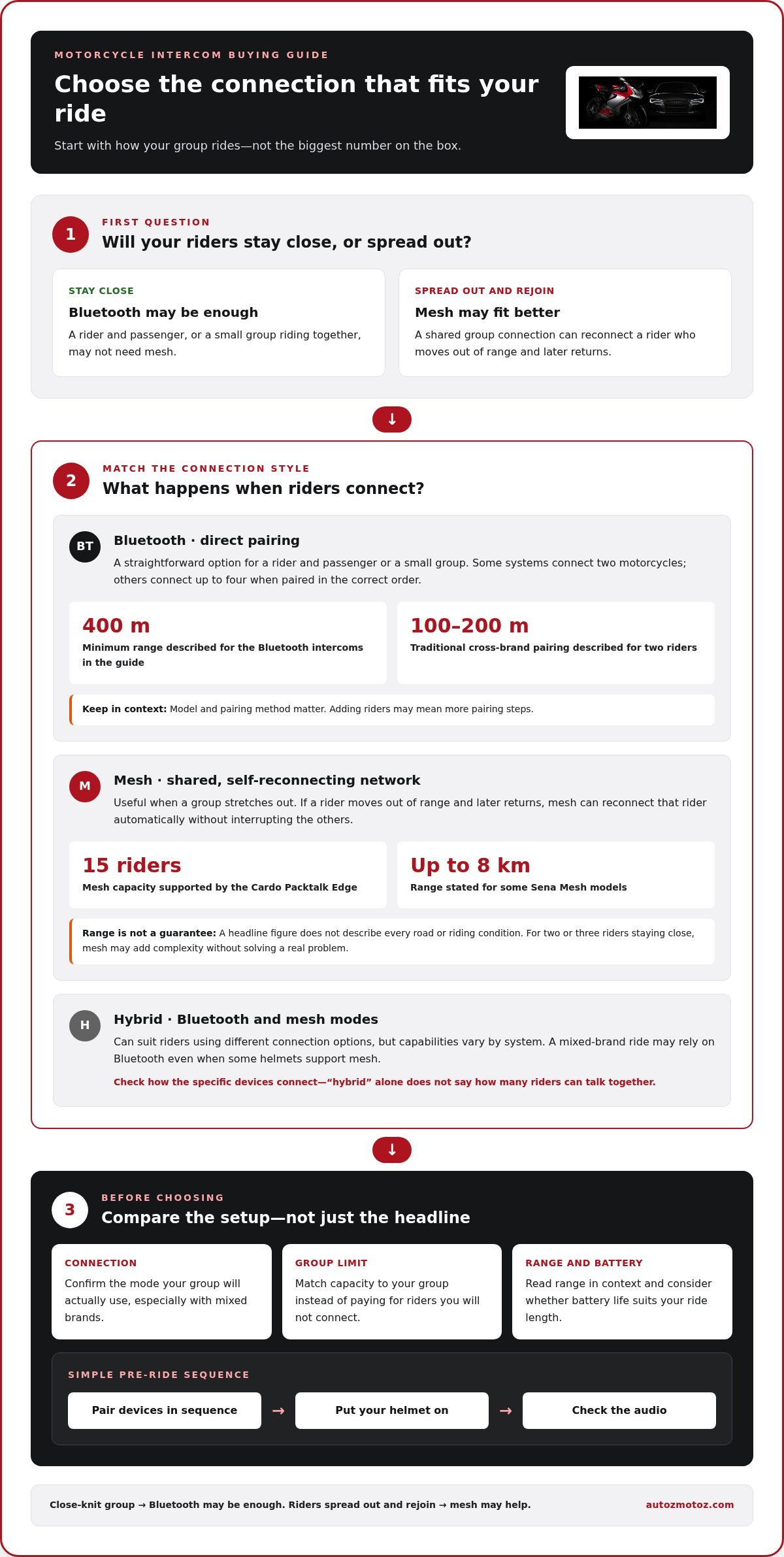
For a passenger or a close-knit group, Bluetooth may be enough; mesh is useful when riders spread out or rejoin. The choice depends on group size, connection behavior, and the rides you actually take.
Bluetooth Communication
Bluetooth pairs helmet intercoms directly, making it a straightforward choice for a rider and passenger. Some systems connect two motorcycles, while others can connect up to four when paired in the correct order. The described Bluetooth intercoms have a minimum range of 400 m, but traditional cross-brand pairing is described at 100-200 meters for two riders. Model and pairing method matter.
Bluetooth can be an efficient option for small groups, but adding riders may mean more pairing steps. Before setting out, pair the devices in sequence and check the audio with your helmet on. Noise cancellation may improve sound clarity, but it won’t increase group capacity or range.
Mesh Communication
Mesh networking connects riders through a shared group connection instead of relying only on a fixed chain of individual pairings. If someone moves out of range and later returns, mesh can reconnect that rider automatically without interrupting the others. This can help when a group stretches out on the road.
Capacity depends on the system: the Cardo Packtalk Edge supports mesh connectivity for 15 riders. Some Sena Mesh models have a range of up to 8 km, but a headline range doesn’t describe every road or riding condition. For two or three riders staying close, mesh usually adds complexity without solving a real problem.
Hybrid systems combine connection modes, so check which mode your group will actually use. A mixed-brand ride may rely on Bluetooth pairing even when some helmets support mesh. Check how the specific devices connect before choosing: “hybrid” alone doesn’t tell you how many riders can talk together.
| Option | Connection style | Group fit | Key trade-off |
|---|---|---|---|
| Bluetooth | Direct pairing | Rider-passenger or small group | Pairing order can matter |
| Mesh | Shared, self-reconnecting network | Groups that spread out | More capacity may be unnecessary |
| Hybrid | Bluetooth and mesh modes | Riders using different connection options | Capabilities vary by system |
Choose Bluetooth for a close-knit pair or small group; choose mesh when riders need to leave and rejoin without breaking the conversation. Compare connection mode, group limit, and range together, then consider whether the battery life suits your ride length.
What is the best motorcycle helmet communication system?
The best system is one that fits your helmet, works with your riding group, and has controls you can use without fumbling. Compare fit and everyday usability before treating a feature list as the final word.
Are motorcycle intercoms legal to use while riding in the United States? Rules can vary by state, so there isn’t one answer that applies everywhere. Check the rules in the states where you ride.
What safety risks or drawbacks should you consider before using a motorcycle intercom? Conversation and fiddly controls can distract you, while loud audio can make surrounding sounds harder to hear. Keep the volume moderate and set up pairing before riding.
Helmet Compatibility and Installation
Helmet fit is the first filter: a communication system needs room for its speakers and microphone without disrupting the helmet’s fit. The Sena SRL2 is designed for the Shoei Neotec 2 and two other Shoei helmet models, making its fit more helmet-specific than a general-purpose unit.
Before choosing, match the system to your motorcycle helmet and check where its speakers sit around your ears. A comfortable fit matters more than a long feature list if the speakers press uncomfortably or the microphone gets in the way.
Intercom Brands and Features
Midland’s models show how features can matter more than a brand label. The BTX1 Pro S supports communication for up to 4 people, while the BTX2 Pro S LR has a dual Bluetooth chipset and long range. Those differences suit different priorities: group size versus its stated connection setup.
Compare the exact model, not just the manufacturer. To assess sound quality, consider speaker placement and noise-cancellation claims alongside how your group will communicate. Neither a brand name nor a specification alone tells you how the system will perform on your ride.
Controls and Device Compatibility
Controls should be usable with your riding gloves. The Midland BT Mini has a three-button interface designed to be operated while wearing thicker winter gloves, unlike controls that may be harder to find by touch.
Check which devices the system can pair with and whether your riding partners use compatible connection options. While stationary, test the button layout, pair the devices, and listen for clear audio. Simple controls can make it easier to stay connected without looking away from the road.
Premium intercom systems for group riding
Premium group systems differ in rider capacity, channel setup, and how they handle shared conversation. The Snell E-2, Midland R1 Mesh, and Moman H2 illustrate why the rider count alone doesn’t tell the whole story.
Group Communication
Group communication keeps riders connected for useful updates, such as a route change or a stop ahead. A rider-to-passenger link mainly serves two people on one motorcycle, while a group system needs to keep multiple helmets in the conversation as the formation shifts.
Before riding, agree on who will give directions and keep messages brief. Stable audio and well-placed speakers help riders listen without constantly adjusting their setup. Advertised capacity won’t improve communication if the group hasn’t agreed when and how to speak.
Intercom Capacity
Capacity is the number of people a system can connect at once, but the examples vary. The Snell E-2 supports up to four riders, the Midland R1 Mesh allows six people to communicate simultaneously, and the Cardo Packtalk Bold Duo JBL supports up to 15 riders at a time.
Choose for your regular group, not the biggest ride you might join once. If your usual crew fits the Snell E-2’s limit, extra capacity may add little practical value. For larger groups, compare how the system keeps riders connected, not just the maximum number printed in its specifications.
Group-Intercom Channel Capacity
Channels describe how communication is organized, not necessarily how many riders can join. The Moman H2 supports two communication channels, a specification that differs from the rider limits listed for the Snell E-2 or Midland R1 Mesh.
Check what each channel is designed to handle before assuming that “two channels” means two groups of any size. Decide whether separate conversations would help your ride or split riders who need the same directions. Then compare the channel setup with battery life and audio quality for the full trip.
For a close-knit group, prioritize clear communication and a capacity that fits your regular rides. For larger outings, compare the Midland R1 Mesh’s six-person simultaneous communication with the Cardo Packtalk Bold Duo JBL’s 15-rider capacity, then weigh channel needs and battery life.
Intercom prices and product specifications
A higher price doesn’t automatically mean a better fit. Compare the price tier with the features you’ll use, then weigh connectivity, range, battery life, and helmet compatibility against your riding style. A solo headset and a two-rider kit are different purchases, so compare like with like.
Bluetooth version is one specification, not a verdict. The Cardo Freecom 4X uses Bluetooth 5.2, the ASMAX F1 and F1s use Bluetooth 5.3, and the Snell E-2 uses Bluetooth 5.0. Those labels help identify connectivity standards, but they don’t tell you group capacity, comfort, or how well the system fits your helmet.
Range claims also need context. The Moman H2 lists up to 1,000 m, while the Moman H3 lists up to 2,000 m; a listed 1,000 m range is described as delivering 500-700 m in practice. Compare the same conditions and connection mode, rather than treating a larger figure as a guarantee of better communication on every ride.
Battery specifications can make a difference on longer trips. The Sena 50R offers up to 13 hours of talk time, while the Sena SMH5 offers up to 7 hours. Match stated talk time to your planned ride, and consider whether charging time or a Type-C connection matters to your routine. For example, the Moman H2 and H3 use Type-C charging.
- Prefer mesh when group communication is the priority; choose Bluetooth when its connection limits fit your group.
- Compare single and duo bundles separately, and assess the included headsets against your passenger setup.
- Use range, battery, and compatibility specs together; no single number describes the whole intercom system.
Prices vary with the model, connection type, and bundle contents. Compare brands by the specifications that support your actual riding style, then use focused accessory reviews and comparisons to narrow your shortlist.
AutozMotoz: Reviews and comparisons of automotive accessories and products
AutozMotoz publishes reviews and comparisons of automotive accessories and products to help you weigh specifications against your riding needs. For a motorcycle intercom, narrow your shortlist by connection type, group capacity, helmet fit, and the features that matter on your rides, rather than chasing the biggest number on the box.
Use these comparisons when two models look similar or a premium feature list makes the choice less clear. Apply this guide’s criteria to focus on practical differences, such as how each system supports your group and which specifications affect everyday use.
Visit autozmotoz.com to explore reviews and comparisons of automotive accessories and products.
Make the Next Ride Easier to Coordinate
Before choosing a system, get your regular riding group on the same page. Agree on what you need the intercom to do, who needs to speak, and which features would genuinely improve your rides. A quick conversation can help avoid buying around one rider’s preferences while leaving everyone else with a setup they rarely use.
Use this motorcycle intercom buying guide as a starting point, then narrow your shortlist to systems suited to the group you ride with most often. If you’re comparing options, AutozMotoz’s reviews and comparisons of automotive accessories and products can help you assess the differences without getting sidetracked by spec-sheet hype.
Explore AutozMotoz’s accessory reviews and comparisons, and choose a system that fits the way you ride. A practical choice can make group communication feel less like another task and more like part of the ride.
Frequently Asked Questions
Can different brands connect without buying the same intercom?
Yes, different brands can connect through traditional Bluetooth pairing, but cross-brand communication is generally limited to a two-rider connection. Pairing steps and available functions can differ by model, so test the connection while stopped and make sure both riders can reconnect after powering off. Treat cross-brand compatibility as model-specific, rather than assuming every feature will work across brands.
Do I need mesh if I only ride with two or three people?
No, mesh usually isn’t necessary if two or three riders stay close and ride together. A rider and passenger can often get what they need from a straightforward Bluetooth setup. Mesh becomes more useful if the group tends to spread out or riders frequently leave and rejoin the conversation. Base the choice on your group’s habits, not the most advanced-sounding feature.
Does weather affect intercom performance?
Weather can affect the audio experience: wind noise, rain, and a wet helmet can make listening harder, even if the intercom stays connected. Position the microphone as intended and avoid covering speaker openings with loose helmet padding. Water protection varies by model, so use the unit within its stated limits rather than assuming every intercom handles wet conditions equally well.
How do wireless Bluetooth communication systems work?
A Bluetooth helmet system uses short-range radio to pair compatible devices, such as two intercoms or an intercom and a phone. Motorcycle intercoms use 2.4 GHz radio transmission. Once paired, the headset sends and receives audio wirelessly, letting riders speak without holding a phone. Pair devices while stopped, then confirm the connection and audio before setting off.
How many riders can connect at once?
It depends on the system and connection mode. Bluetooth intercoms are described as supporting 2-4 riders, while mesh products can support larger groups; the Cardo Packtalk Edge supports mesh connectivity for 15 riders. Compare the stated number of simultaneous riders, not just how many devices a system can pair. Those figures describe different capabilities and aren’t interchangeable.
Motorcycle Intercom vs Earbuds: Which Is Better?
A helmet intercom is designed for rider communication, while earbuds mainly play audio from a personal device. For group rides, an intercom lets you speak with another rider without handling a phone. This motorcycle intercom buying guide can help you compare that group function with the simpler role of earbuds. Choose gear that fits under your helmet and keep audio low enough to stay aware of surrounding sounds.